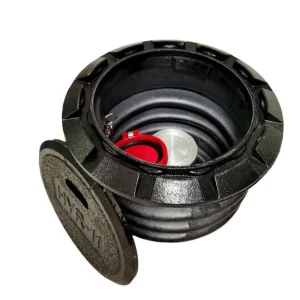
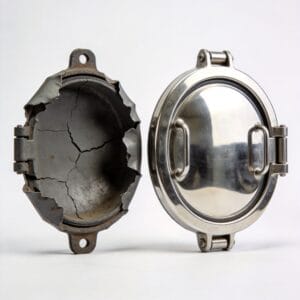
In the annals of cosmic exploration, tales of rockets and rovers often capture our imagination, but what if one of the fastest objects ever propelled wasn’t designed for space at all? Enter the fascinating saga of the “manhole cover in space speed.” It might sound like a quirky urban legend, but this story stems from a real mid-20th century experiment that inadvertently sent an ordinary manhole cover soaring into the cosmos at unprecedented speeds. Picture it: the Cold War era, a pivotal moment in nuclear testing, and an unlikely object reaching velocities that would rival even the most advanced spacecraft today.
Unbeknownst to many, the manhole cover’s unintended flight was a byproduct of Operation Plumb bob, a series of tests conducted in Nevada in 1957. During one of these tests, an underground nuclear explosion catapulted a steel plug, similar to a manhole cover, towards the heavens at such incredible speed that it likely escaped Earth’s gravitational pull altogether. This extraordinary event not only challenges our understanding of speed and motion but also prompts a reevaluation of the man-made objects that could potentially be drifting into the vastness of space. Dive into this intriguing narrative where science fiction meets reality, and explore the enigma of an object whose journey represents one of the most curious anomalies in space exploration history.
Operation Plumb bob: Unveiling the Nuclear Testing Project
Operation Plumb bob was a landmark series of nuclear tests carried out by the United States between May and October of 1957 at the Nevada Test Site. Conceived during the height of the Cold War, this project aimed to analyze weapon yield efficiencies, radiation effects on equipment and living tissue, and the geological impact of underground detonations. Plumb bob encompassed 29 individual detonations, varying in yield from a few kilotons to more than 60 kilotons. It was the most extensive and publicized series of tests the U.S. had conducted up to that point, drawing both scientific and military attention worldwide.
Test preparations involved drilling deep shafts into the desert floor to contain the blasts and protect the surrounding environment to some degree. Instruments were strategically placed to monitor shock waves, seismic activity, and radiation dispersal. Among the many unique experiments was the deliberate emplacement of a heavy steel plate—an object akin to a manhole cover—to study the forces exerted by the blast’s pressure. This precaution turned out to be the catalyst for one of the most extraordinary and unexpected discoveries in the history of nuclear testing: the potential of an everyday object to achieve unprecedented velocities and penetrate the upper atmosphere.
The Unintended Projectile: Manhole Cover Soaring into Space
During one particular test dubbed “Pascal-B,” scientists positioned a one-ton steel plate over the summit of a vertical borehole. The intention was to measure the velocity of shock waves moving upward through the drilled shaft. When the nuclear device detonated about 500 feet underground, the explosive force created a superheated gas that shot the steel plate upward at incredible pressure. Calculations based on instrumentation suggested that the plate was propelled at a minimum of Mach 10, with some estimates reaching Mach 20. At such speeds, this steel plug holds the unofficial record for the fastest man-made object ever launched by an explosion.
This act—unplanned in its final trajectory—speaks directly to the phenomenon we refer to as “manhole cover in space speed.” While no direct observation of the plate’s flight or its ultimate fate was possible, physics models imply that it could have exceeded escape velocity. If so, our mundane manhole cover would have entered a solitary orbit around the Sun, making it the only known piece of terrestrial debris flung into interplanetary space by a nuclear test. Inadvertently, scientists had created a cosmic projectile whose journey would remain shrouded in mystery.
Cosmic Anomaly: The Curious Case of the Manhole Cover’s Journey
The plausibility of the manhole cover achieving escape velocity has intrigued researchers for decades. Variables such as the extreme heat generated by the explosion, rapid expansion of gases, and frictional heating during atmospheric passage all factor into whether the plate disintegrated or remained intact. While some experts argue that atmospheric drag and thermal stresses would have melted or fragmented the plate before it reached outer space, others maintain that its initial speed might have been high enough to overcome these destructive forces.
Centuries from now, this piece of steel could be drifting through the solar system, its existence unknown to astronomers. Even if it burned up or broke apart, microscopic fragments may still be somewhere between Earth and the asteroid belt. The case exemplifies a rare intersection of military testing and unintended space exploration. It challenges standard narratives by suggesting that relatively low-tech objects can, under extreme conditions, breach our planet’s confines and join the celestial interplay beyond.
Repercussions of High-Speed Ejection: Implications for Space Debris
The notion of a manhole cover transforming into space debris may sound whimsical, but it underscores serious considerations for the modern space era. Space agencies now grapple with the growing hazards posed by defunct satellites, spent rocket stages, and micrometeoroids traveling at several kilometers per second. Each fragment, however small, poses a collision risk to active spacecraft and crewed missions. The “manhole cover in space speed” anecdote is a cautionary tale: even non-spacefaring nations or industries could inadvertently pollute orbital regions.
Emerging policies on orbital debris mitigation emphasize responsible end-of-life disposal, active debris removal, and strict launch protocols. The Phantom Plate incident serves as a historical footnote that presciently anticipates these modern challenges. It highlights the need for comprehensive monitoring of any object—planned or accidental—that attains such disruptive velocities. As we push further into low Earth orbit, lunar environs, and beyond, informed strategies will be vital to preserve the long-term viability of space operations and ensure the safety of future explorers.
Beyond Earth’s Boundaries: The Legacy of the Manhole Cover in Space
Although the fate of the Pascal-B plate remains speculative, its enduring legacy lies in inspiring both wonder and solemn reflection. In the 21st century, the story of the manhole cover propelled into orbit resonates as a metaphor for human ingenuity and the unintended consequences of technological advancement. It reminds us that monumental breakthroughs sometimes arise from the most unexpected experiments. Beyond textbooks of nuclear physics, it exists as an emblem of how ordinary objects can cross extraordinary frontiers.
Today’s space missions—be they robotic explorers or crewed voyages—often employ cutting-edge materials engineered to survive harsh conditions. Yet, the Pascal-B incident demonstrates that raw physical forces can launch even simple steel plates on audacious trajectories. This paradox continues to inspire aerospace engineers and historians alike. Their research into high-velocity impacts, materials science, and orbital mechanics often references this episode, acknowledging that our understanding of space is as much shaped by chance phenomena as by deliberate exploration.
Concluding the Enigma: Reflections on a Historic Space Oddity
The tale of the manhole cover launched by Operation Plumbbob remains one of the most intriguing space oddities in modern history. It bridges the realms of nuclear physics, aerospace engineering, and cosmic exploration, illustrating how a routine test unwittingly birthed an interstellar traveler. Despite decades of research, the plate’s ultimate destination—whether it or its fragments still roam the solar system—remains one of space science’s most tantalizing mysteries.
As we continue to chart the heavens with advanced telescopes and interplanetary probes, the story serves as a humbling reminder: sometimes, it is not the grandest vessels but the humblest objects that capture our imagination and expand our sense of possibility. The manhole cover that may still orbit the Sun stands as a testament to human curiosity and the unpredictable pathways of exploration.