

Quick answer: Most failures traced to inspect manhole cover checklist start with poor bedding, blockages or a load class that was wrong for the site. A simple routine — visual inspection, clearing silt, checking that the unit sits flat and verifying locks — prevents the large majority of problems.

What this guide covers
This guide explains everything you need to know about inspect manhole cover checklist. Whether you are a municipal engineer, a civil contractor, a distributor or a facility manager, the right decision starts with understanding how the product is made, which standard it must meet, and where it will be installed. We have kept the discussion practical and grounded in real product specifications so you can apply it directly to your next project.
Across infrastructure projects, the cost of getting a specification wrong is rarely the price of the product itself. It is the rework, the delayed hand-over, the callbacks after the first heavy rain, and in the worst case a safety incident. Treat inspect manhole cover checklist as a system decision rather than a line item, and the rest of the specification usually follows naturally.
Why the right specification matters
Selecting the correct configuration for inspect manhole cover checklist affects safety, service life and total cost in equal measure. A cover or channel that is under-rated for the traffic it carries will crack or deform; one that is over-specified wastes budget and can create handling problems during installation. The goal is to match the product to the actual duty of the site.
Manufacturers express performance through a small set of reproducible parameters: material, load class, clear opening, frame dimensions and the standard against which the product is tested. Once you can read those parameters, most selection questions answer themselves. The tables and examples below use published figures from real product lines.
| Parameter | What it tells you | Typical range |
|---|---|---|
| Material | How the product resists corrosion, load and wear | SMC, BMC, FRP, polymer concrete, HDPE, ductile iron |
| Load class | Maximum test load under EN124 or AASHTO | A15 to F900 |
| Clear opening | Usable access or flow aperture | 250 mm to 1100 mm+ |
| Standard | The compliance framework | EN124 / EN1433 / AASHTO / ISO 9001 |
Understanding load classes
Load class is the single most important safety parameter. Under EN124, a class is defined by the test load the cover or grate must withstand and the area over which that load is applied. Choosing a class is about the traffic that will actually cross the product, not the maximum figure available in a catalogue.
| Class | Application area | Typical usage |
|---|---|---|
| A15 | Pedestrian and bicycle areas | Gardens, parks, patios, walkways |
| B125 | Sidewalks and light vehicle areas | Driveways, pedestrian zones |
| C250 | Road shoulders and kerbside channels | Service stations, parking edges |
| D400 | Roadways and heavy traffic areas | Main roads, highways, hard shoulders |
| E600 | Industrial zones, ports, airports | Docks, heavy industrial wheel loads |
| F900 | Aircraft pavements and extreme loads | Airport runways, dockyards |
A frequent mistake is to select by vehicle weight alone. Braking forces, wheel configuration and the dynamic amplification of a loaded truck matter just as much. When in doubt, move up one class at a kerbside or in an area subject to occasional overloaded vehicles.
Materials compared
Material choice drives almost every other property: weight, corrosion behaviour, electrical insulation, colour options and unit cost. Composite materials have become the default for many municipal and industrial projects precisely because they combine corrosion resistance with a low weight that is safe for manual handling.
| Material | Key characteristics |
|---|---|
| SMC composite | Sheet Molding Compound; light, corrosion-free, no scrap value, good insulation |
| BMC composite | Bulk Molding Compound; high strength, dimensionally stable, chemical resistant |
| FRP / fiberglass | Fiber-reinforced plastic; high strength-to-weight, corrosion resistant, low maintenance |
| Polymer concrete | Ultra-high compressive strength, zero water permeability, rapid shaping |
| HDPE | High-density polyethylene; chemical resistant, lightweight, impact resistant |
| Ductile iron | Very high load capacity, traditional, heavy, recyclable |
No single material is best for every site. Ductile iron still wins where extreme point loads and a familiar supply chain dominate, while composites win where corrosion, theft or manual-handling safety are the deciding factors. Polymer concrete and HDPE occupy the drainage-focused middle ground.
Real-world specifications
The following examples are drawn from published product data and show how the parameters discussed above come together in practice. They illustrate the range available; always confirm the exact drawing and test certificate for your specified model before ordering.
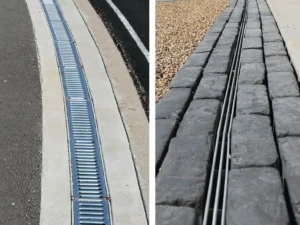
U100 Polymer Concrete Drainage Channel | EN1433 Linear Drainage System
Example — U100 Polymer Concrete Drainage Channel | EN1433 Linear Drainage System. A purpose-built unit in this product family.
450×450 SMC Composite Square Manhole Cover
Example — 450×450 SMC Composite Square Manhole Cover. Material: SMC Composite Load class: A15 / B125 / C250 / D400 Clear opening / size: 450 × 450 mm Standard: EN124
Published dimensional data: Load Class Clear Opening Cover Size Frame Size Overall Height Cover Thickness Weight A15 450x450mm 500x500mm 590x590mm 35mm 25mm 9kg B125 450x450mm 500x500mm 590x590mm 35mm 25mm 15kg C250 450x450mm 500x500mm 620x620mm 75mm 50mm 28kg D400 450x450mm 500x500mm 620x620mm 75mm 50mm 35kg.
Premium HDPE Drainage Channel Cover With Anti-Slip Surface
Example — Premium HDPE Drainage Channel Cover With Anti-Slip Surface. Load class: class A15 Type 450x500x30mm pl Standard: CE Typical application: Road drainage system Greentech channel are
Operation and maintenance
A simple inspection regime extends service life and prevents small defects from becoming expensive failures. Most manufacturers recommend a visual check after installation, a first inspection after the initial settling period, and then a scheduled annual review.
- Check that the cover or grate sits flat and does not rock under foot or wheel load.
- Look for cracks, spalling or deformation of the frame and surrounding surface.
- Clear silt and debris from channels and gully inlets so design flow is maintained.
- Confirm locking mechanisms operate and that anti-slip surfaces remain effective.
- In corrosive environments, inspect fixings and any exposed metal components.
Keep a maintenance log with dates, findings and actions. Trend data quickly reveals a location that is repeatedly damaged, which usually points to an underlying traffic or drainage problem rather than a defective product.
Where this is used: Installed infrastructure across all environments
This topic is most relevant to installed infrastructure across all environments. Matching the product to the environment is what separates a specification that lasts from one that generates callbacks.
- Live road works
- Industrial plant maintenance
- Municipal drainage networks
- Residential areas
- Port and logistics facilities
Installation quality and a disciplined inspection routine decide service life more than any single product attribute. Confirm the exact load class, dimensions and standard against the conditions at your own site before ordering.
Installation best practice
Even a perfectly specified product will fail early if it is installed badly. The bedding, the surrounding concrete and the level of the finished surface determine how load is transferred into the ground and how the product behaves over thousands of traffic cycles.
- Excavate to the design level and compact the sub-base to the specified density.
- Seat the frame or channel on a firm, level bedding layer; never point-load the unit on loose ground.
- Set the finished top face flush with the surrounding pavement to avoid impact from wheels.
- Haunch or encase as required so the frame is fully supported along its perimeter.
- For composite units, use the prescribed lifting points and avoid dragging the cover across abrasive surfaces.
- Record the as-built level and take a photograph before the surface is closed.
Allow the surrounding concrete to reach its design strength before opening the area to traffic. Rushing this step is one of the most common causes of early rocking, noise and settlement.
Operation and maintenance
A simple inspection regime extends service life and prevents small defects from becoming expensive failures. Most manufacturers recommend a visual check after installation, a first inspection after the initial settling period, and then a scheduled annual review.
- Check that the cover or grate sits flat and does not rock under foot or wheel load.
- Look for cracks, spalling or deformation of the frame and surrounding surface.
- Clear silt and debris from channels and gully inlets so design flow is maintained.
- Confirm locking mechanisms operate and that anti-slip surfaces remain effective.
- In corrosive environments, inspect fixings and any exposed metal components.
Keep a maintenance log with dates, findings and actions. Trend data quickly reveals a location that is repeatedly damaged, which usually points to an underlying traffic or drainage problem rather than a defective product.
Frequently asked questions
What does the load class actually mean?
It is the test load, defined by a standard such as EN124, that the product must withstand. It is a performance classification, not simply a statement of how heavy the unit is.
Are composite products strong enough for roads?
Yes, when specified to the correct class. D400 units are designed for main roads and highways, and E600/F900 units serve industrial, port and airport environments.
How long do they last?
Service life depends on the environment and load cycle, but corrosion-resistant composites routinely outlast coated metal products in wet, coastal or chemical locations with far less maintenance.
Can I get a custom size or logo?
Yes. OEM and ODM capability covers custom dimensions, logos, patterns and colours. Confirm the drawing and any tooling requirements before placing the order.
Continue reading
- Comparing Quotes: What Is Really Included
- Common Mistakes in Manhole Cover Selection and Installation
- How to Budget a Drainage Infrastructure Project
- How Distributors Can Expand Their Drainage Range

 English
 Español
 Русский
