
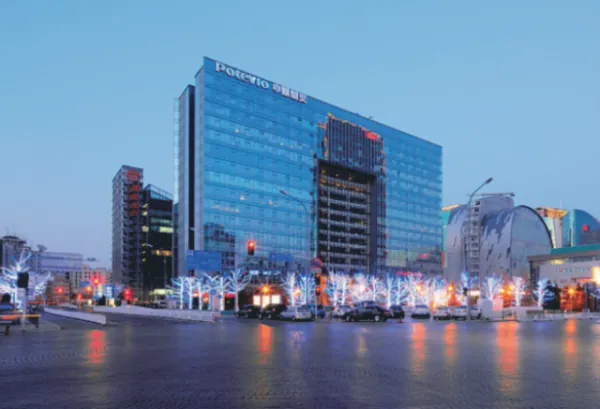
Project Overview
The Weihai Zhongguancun Plaza Drainage Channel Project was carried out in a commercial plaza area with long continuous runs of drainage channels, placing high demands on overall straightness and elevation control. The original drainage approach posed a major challenge because any local deviation in such a long run would be easily amplified, subsequently affecting pavement installation and drainage performance. To solve this, the project adopted plastic drainage channels paired with slotted covers, which provide efficient drainage while allowing on-site fine adjustments. During early construction, baseline alignment and key control points were established with the on-site team, with continuous calibration throughout installation to ensure overall continuity. This upgrade has resulted in clean, uniform drainage lines that integrate naturally with the pavement, delivering stable drainage performance while meeting both the functional requirements and aesthetic details of the commercial space.
The Challenge: Long Runs Demand Precision
Commercial plaza drainage is different from small-scale landscape or roadway drainage. When a drainage system runs continuously for tens or even hundreds of meters, small problems become big problems.
Consider this: A deviation of just 5 millimeters (0.2 inches) in straightness over a 2-meter section might be invisible. But over a 50-meter run, that same 5-millimeter error at each joint can accumulate into a noticeable curve or wobble. Similarly, an elevation error of 3 millimeters at one channel section might not affect water flow locally, but multiple small errors along the run can create ponding, poor drainage direction, or an uneven interface with paved surfaces.
For the Weihai Zhongguancun Plaza project, these precision requirements were not optional. The commercial plaza demanded:
| Requirement | Why It Matters |
|---|---|
| Precise overall straightness | A wavy or crooked drain line looks unprofessional and cheapens the plaza appearance |
| Consistent elevation control | Ensures water flows correctly and covers sit flush with pavement |
| Uniform joint alignment | Prevents visible gaps or stepped transitions between channel sections |
| Natural pavement integration | Drainage lines should complement, not clash with, surrounding hardscape |
| Stable long-term drainage performance | Must handle plaza stormwater without flooding or clogging |
Traditional drainage systems often struggle with these demands. Concrete channels, while strong, have inherent limitations: they are heavy, difficult to adjust once set, and prone to minor shifts during backfill. Metal systems can be precision-fabricated but are expensive and offer little on-site adjustability.
The project needed a system that could be installed with precision, adjusted on site when necessary, and maintain alignment over long runs.

The Solution: Plastic Drainage Channels with Slotted Covers
For this commercial plaza application, the GREENTECH team selected plastic drainage channels (high-quality polymer concrete or HDPE, depending on specific load requirements) paired with slotted covers—a system designed for both precision installation and long-term performance.
1. Plastic Drainage Channels: Lightweight, Precise, and Consistent
Modern plastic drainage channels (often made from polymer concrete or HDPE) offer significant advantages for long-run installations:
Factory-precision dimensions – Each channel section is manufactured to tight tolerances, ensuring consistent fit from piece to piece
Lightweight handling – Easy for crews to position, adjust, and reposition without heavy equipment
Integral connection systems – Channels lock together with positive alignment features that maintain straightness
Smooth interior surfaces – Excellent flow characteristics with minimal friction loss
Corrosion-resistant – Unaffected by deicing chemicals, fertilizers, or standing water
The key advantage for this project: the channels come out of the box straight and stay straight. Unlike cast-in-place concrete, which depends on on-site formwork quality, or precast concrete, which can warp or vary, plastic drainage channels provide consistent geometry section after section.
2. Slotted Covers: Clean Appearance with Fine Adjustment Capability
The slotted cover design complements the plastic channel system perfectly:
Narrow slot opening – Captures surface water efficiently while remaining visually discreet
Strong, durable material – Stainless steel or high-strength composite options available
Height-adjustable – Cover elevation can be fine-tuned during installation to match finished pavement
Clean, minimalist appearance – The slot disappears into the pavement line
Debris-resistant – Narrow openings prevent leaves and litter from entering the drain
For a commercial plaza where appearance matters, the slotted cover is ideal. Unlike grated drains that create a visible “industrial” look, the slotted cover reads as a clean line in the pavement.

3. Pre-Installation Planning: Baseline and Control Points
Before any installation began, the GREENTECH team worked with the on-site crew to establish:
Baseline alignment: A reference line was set along the entire drainage run, typically using string lines, lasers, or total station surveying equipment. This baseline defined the exact straight line the channels would follow.
Key control points: Specific points along the run were identified for elevation and alignment verification. These control points served as checkpoints during installation—if the system deviated at a control point, the crew would know immediately.
Grade and slope calculations: The required slope for positive drainage was calculated based on plaza surface gradients, rainfall intensity, and drainage outlet locations.
This upfront planning transformed a potentially chaotic installation into a systematic, verifiable process.
4. Continuous Calibration During Installation
The installation itself was not a “set it and forget it” operation. The crew performed continuous calibration:
After placing each 2-4 channel sections, straightness was checked against the baseline
Elevation was verified at each control point using a laser level or transit
Joint alignment was inspected to ensure smooth transitions between sections
Adjustments were made immediately if any deviation was detected
Because the plastic channels are lightweight and the connection system allows minor positional adjustment, the crew could fine-tune alignment without major rework. A channel section slightly off-line could be nudged back into position. A joint that wasn’t perfectly flush could be adjusted.
This continuous calibration ensured that local deviations never accumulated into global problems.
5. On-Site Fine Adjustment Capability
Even with careful planning, real-world conditions on a commercial plaza site can vary:
Pavement thickness might differ slightly from drawings
Adjacent trades might have shifted a curb line or manhole location
Subgrade compaction might settle more in some areas than others
The plastic + slotted cover system accommodates these variations:
Length adjustment: Channel sections can be cut to exact length on site using simple tools.
Height adjustment: Slotted covers sit on adjustable brackets or frames, allowing fine-tuning of finished elevation to match pavement thickness variations.
Minor realignment: The channel connection system allows slight rotational or lateral adjustment before final backfill.
This flexibility meant the installation team could respond to field conditions without tearing out completed work or waiting for custom-fabricated replacements.
The Installation Process: Precision in Practice
With the baseline established, control points marked, and continuous calibration planned, the on-site installation proceeded systematically.
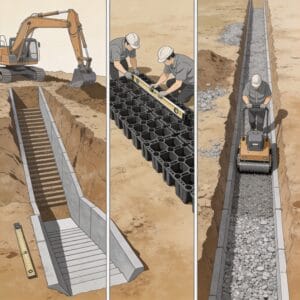
Step 1: Trench Preparation
The trench was excavated to the required width and depth, with subgrade compacted to prevent future settlement. The baseline alignment was transferred to the trench bottom so the crew could position channels accurately.
Step 2: Channel Placement
Starting from the downstream (outlet) end, the crew placed channel sections one by one:
Each section was set to the correct elevation using laser-guided screed rails or adjustable supports
Straightness was verified against the baseline after every few sections
Channels were locked together using the integral connection system
Joints were inspected for smooth transitions
Because the plastic channels are lightweight, a two-person crew could handle sections that would require machinery for concrete equivalents.
Step 3: Continuous Verification
At each control point, the crew paused to verify:
Alignment relative to baseline (straightness tolerance: ±2mm over 10 meters)
Elevation relative to design grade (slope tolerance: ±1mm per meter)
Joint smoothness (no steps or gaps between sections)
When minor deviations were found (and on a long run, some always appear), the crew made immediate adjustments. A section was nudged left or right. A support was raised or lowered. The problem was corrected before it could propagate.
Step 4: Cover Installation and Height Adjustment
After the channels were set and backfilled, the slotted covers were installed. The adjustable brackets allowed final height tuning to match the surrounding pavement elevation.
This step was critical. Because the plaza pavement might have slight thickness variations across the run, the cover height could be fine-tuned section by section to achieve a perfectly flush finish everywhere—no covers sitting too high (trip hazard) or too low (water pooling).
Step 5: Final Verification
After full installation, the entire run was re-verified for straightness and elevation. The result: clean, uniform lines with no visible wobble or deviation.

The Results: Clean Lines, Natural Integration, Stable Performance
After project completion, the Weihai Zhongguancun Plaza drainage system has performed exactly as designed.
Clean, Uniform Drainage Lines
The final installation shows perfectly straight drainage lines from end to end. No visible curves. No wavy joints. No stepped transitions between sections.
For a commercial plaza where attention to detail reflects on the developer and property manager, this visual perfection matters. The drainage system does not draw attention to itself—it simply disappears into the pavement as a clean, subtle line.
Natural Pavement Integration
The slotted covers sit flush with the surrounding paving material. The narrow slot is visually minimal while remaining fully functional for water capture.
From a standing position, a visitor might not even notice the drain. They would only see a clean line in the pavement—and that is exactly the intent. Good drainage should be felt (by the absence of standing water) rather than seen.
Stable Drainage Performance
The system delivers reliable, stable drainage for the commercial plaza. During rain events, surface water flows efficiently into the slots without ponding or overflowing. The smooth interior of the plastic channels prevents debris buildup and maintains flow capacity over time.
The commercial plaza remains dry, safe, and usable even during heavy rain.
Functional and Aesthetic Balance Achieved
The project successfully balanced two often-conflicting goals:
Functionality: The drainage system captures and conveys water reliably, preventing flooding and slip hazards
Aesthetics: The clean slot lines, uniform straightness, and flush pavement integration meet the high visual standards of a commercial plaza
This balance is not accidental. It resulted from careful system selection, thorough pre-installation planning, continuous on-site calibration, and the inherent precision of plastic channels with adjustable slotted covers.
Field Feedback
The project team offered positive feedback on several fronts:
On the planning process: “Establishing the baseline and control points upfront made the installation systematic. We knew exactly what to check and where.”
On the installation ease: “The plastic channels are light and easy to handle. We could position them accurately without struggling with heavy sections.”
On the continuous calibration approach: “Checking alignment every few sections caught small issues before they became big ones. That was key to the final straightness.”
On the final appearance: “The drain lines look great—clean, straight, flush with the pavement. Exactly what the plaza required.”
On overall performance: “The drainage works. No ponding, no complaints. The system does its job without being noticeable.”
Comparison: Long-Run Precision Across Systems
| Characteristic | Plastic Channels + Slotted Covers | Cast-in-Place Concrete | Precast Concrete |
|---|---|---|---|
| Straightness consistency | High (factory precision) | Variable (depends on formwork skill) | Medium (can vary between pieces) |
| Elevation control | Excellent (adjustable supports) | Good (but hard to modify) | Fair (fixed dimensions) |
| On-site adjustability | High (cut, shift, height-tune) | Very low (once poured, it’s fixed) | Low (replacement required) |
| Installation speed | Fast (no cure time) | Slow (forming, pouring, curing) | Medium (heavy handling, mortar beds) |
| Visual result | Clean, uniform lines | Visible joints possible | Joint alignment variable |
| Commercial plaza suitability | Excellent | Good (with skilled labor) | Fair |
Conclusion: Precision for Long-Run Commercial Drainage
The Weihai Zhongguancun Plaza Drainage Channel Project demonstrates that long continuous drainage runs do not have to be a source of visual compromise or installation anxiety.
By choosing plastic drainage channels with slotted covers, and combining them with:
Pre-installation baseline and control point planning
Continuous calibration during installation
On-site fine adjustment capability
The project achieved:
Clean, uniform straightness across the entire run
Natural pavement integration with flush cover heights
Stable, reliable drainage performance for the commercial plaza
Balance of functionality and aesthetics meeting commercial space demands
For architects, plaza designers, and contractors working on long-run drainage installations with high visual standards, the GREENTECH plastic channel + slotted cover system offers a proven, precision solution.
Ready to achieve perfect straightness on your next commercial drainage project? Contact us to discuss channel specifications, cover options, and installation support.



 English
 Español
 Русский