
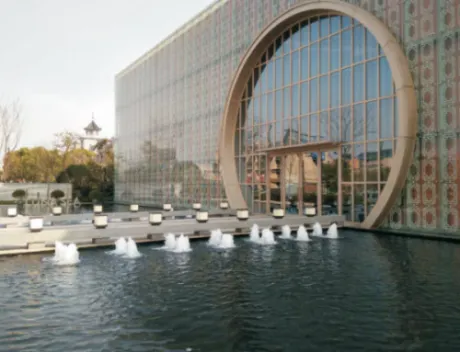
Project Overview
The Vanke Landscape Drainage Channel System Project was carried out in a Vanke landscape area with a tight construction schedule and multiple cross-trade operations on site, placing high demands on construction coordination. The original drainage approach posed a major challenge because any deviation in reserved dimensions or installation position could easily lead to rework, affecting overall project progress. To solve this, the project adopted HDPE drainage channels paired with stainless steel slotted covers, which provide sufficient strength while offering on-site adjustment flexibility. During early coordination, key installation nodes and channel reserved dimensions were confirmed with the construction team to minimize on-site uncertainty. This upgrade has made channel installation smooth and adjustable, effectively reducing rework risk, with the final drainage lines naturally integrating with the pavement for a clean, simple, and efficient result.
The Challenge: Tight Schedule and High-Stakes Coordination
Landscape construction projects are notoriously complex. Unlike single-trade building projects, landscape sites often have multiple crews working simultaneously:
Hardscape installers laying pavers, stone, or concrete
Softscape teams planting trees, shrubs, and ground covers
Irrigation specialists running water lines
Electrical contractors installing lighting and low-voltage systems
Drainage crews responsible for surface water management
In this Vanke landscape project, the drainage system was a foundational element. It had to be installed early enough to allow other trades to work around it, but precisely enough to avoid conflicts with finished surfaces.
The core challenges included:
| Challenge | Risk |
|---|---|
| Tight construction schedule | No margin for delays or major rework |
| Multiple cross-trade operations | High potential for miscommunication and interference |
| Critical reserved dimensions | Even small errors could force costly demolition |
| Fixed installation points | Traditional rigid systems leave no room for field adjustment |
| High aesthetic expectations | Drainage must perform AND look good in a premium landscape |
Under these conditions, a traditional rigid drainage system would be a liability. Cast-in-place concrete trenches require exact formwork and perfect pours. Precast concrete channels have fixed dimensions and no adjustability. If the site conditions change by even a centimeter—due to grade adjustments, paving thickness variations, or neighboring trade work—the drainage system might no longer fit.
The result? Rework. Demolition of completed work. Delays. Cost overruns. Frustration.

The Solution: HDPE Drainage Channels with Stainless Steel Slotted Covers
For this project, the GREENTECH team specified a system combining HDPE drainage channels and stainless steel slotted covers—a solution engineered for both performance and on-site flexibility.
1. HDPE Drainage Channels: Lightweight, Strong, and Adjustable
HDPE (High-Density Polyethylene) drainage channels offer significant advantages over concrete or metal alternatives:
Lightweight – Easy to handle and position without heavy equipment
High strength-to-weight ratio – Capable of withstanding landscape vehicle loads (maintenance trucks, golf carts, light service vehicles)
Smooth interior surface – Excellent flow characteristics, resistant to debris buildup
Corrosion-resistant – Unaffected by soil chemicals, fertilizers, or standing water
Integral connection system – Channels lock together securely without special tools
Most importantly for this project: HDPE channels allow on-site adjustment. Unlike rigid precast concrete, the HDPE system can accommodate minor dimensional variations during installation. If the trench is a few centimeters longer or shorter than planned, the system adapts.
2. Stainless Steel Slotted Covers: Strength, Clean Lines, and Adjustability
The stainless steel slotted cover complements the HDPE channel perfectly:
High load capacity – Suitable for pedestrian and light vehicle traffic
Narrow slot openings – Prevents debris entry while allowing efficient water capture
Clean, minimalist appearance – The slot disappears visually, creating a “hidden drain” effect
Stainless steel construction – No rust, no staining, no maintenance
Adjustable height – Cover height can be fine-tuned during installation to match finished pavement levels
The slotted design is particularly well-suited to high-end landscape projects. Unlike grated drains that collect leaves and debris, the narrow slot stays clean. Unlike catch basins that create obvious “drain” features, the slot integrates seamlessly with paver, stone, or concrete surfaces.
3. Early Coordination: Confirming Key Installation Nodes
Before any materials arrived on site, the GREENTECH team worked closely with the Vanke construction team to:
Verify channel reserved dimensions – Trench width, depth, and length based on final landscape drawings
Identify critical installation nodes – Points where drainage intersects with other utilities or changes direction
Establish elevation benchmarks – Ensuring finished cover height aligns with surrounding pavement
Plan the installation sequence – Coordinating drainage work with neighboring trades to avoid conflicts
This upfront coordination significantly reduced on-site uncertainty. The construction team knew exactly what to expect, where to place the channels, and how to integrate the system with other landscape elements.
4. Built-In Installation Flexibility
The HDPE + stainless steel system provided two specific types of flexibility:
Length adjustment: The HDPE channels can be cut to exact length on site using simple tools. If the excavated trench is slightly longer or shorter than planned, the crew adjusts immediately—no waiting for replacement parts.
Height adjustment: The stainless steel covers sit on adjustable brackets or frames. After the surrounding pavement is installed, the cover height can be fine-tuned to achieve a perfectly flush finish. No more covers sitting too high (trip hazard) or too low (water pooling).
For a tight-schedule project with multiple trades working in the same area, this flexibility was invaluable.
The Installation Process: Smooth, Flexible, Efficient
With early coordination complete and the HDPE/stainless steel system on hand, the on-site installation proceeded efficiently.
Smooth Channel Installation
The lightweight HDPE channels were easy to position within the prepared trench. The crew:
Laid out channels according to the drainage plan
Connected sections using the integral locking system
Verified slope and alignment with laser levels
Backfilled around channels to secure them in place
Because the channels are lightweight and forgiving, the installation was faster than traditional concrete methods. No waiting for concrete to cure. No heavy lifting equipment required. No complicated formwork.
Flexible On-Site Adjustments
When minor field variations appeared—a neighboring trade’s conduit running slightly closer than expected, a paving thickness change—the crew made adjustments on the spot:
Shortened a channel section with a simple saw
Shifted cover height to match finished pavement elevation
Re-routed a short section without major rework
The project supervisor noted that this flexibility eliminated multiple potential rework situations. On a traditional concrete system, each of these variations would have required breaking out completed work and starting over.
Reduced Rework Risk
The combination of early coordination and flexible materials meant the drainage system went in correctly the first time. No demolition. No delays waiting for replacement parts. No finger-pointing between trades.
The construction team reported that drainage installation remained on schedule despite the tight overall timeline and competing trades working in the same zone.
The Results: Clean, Simple, and Efficient
After project completion, the Vanke landscape drainage system has performed exactly as intended.
Natural Integration with Pavement
The stainless steel slotted covers sit flush with the surrounding paving material (stone, concrete paver, or tile). The narrow slot is almost invisible from a standing position—the drain “disappears” into the landscape.
The final effect is clean and simple. No bulky grates. No rusty hardware. No obvious “utility” appearance. Just a subtle line in the pavement that efficiently captures surface water.
Construction Efficiency Achieved
The project was completed on schedule despite the tight timeline. Key efficiency drivers included:
Early coordination eliminated surprises
Flexible materials accommodated on-site variations
Lightweight components sped up handling and positioning
No cure time (unlike concrete) kept the schedule moving
The general contractor specifically noted the drainage system as one of the smoother installations on the project, requiring minimal coordination headaches compared to other trades.

Reduced Rework and Waste
Because the HDPE system allowed field adjustments, there was:
No demolition of incorrectly placed concrete channels
No costly re-ordering of pre-cast sections that didn’t fit
No schedule delays waiting for replacement materials
No arguments between trades about whose work caused the problem
The construction team simply adapted and moved forward.
Long-Term Performance Benefits
Beyond the installation phase, the HDPE + stainless steel system offers ongoing advantages:
Corrosion resistance – No rust stains on surrounding pavement (a common complaint with cast iron grates)
Low maintenance – The smooth HDPE interior resists debris buildup; the stainless steel cover requires no painting or sealing
Debris management – The narrow slot prevents leaves and large debris from entering the drain
Durable – Resists freeze-thaw cycles, UV exposure, and chemical deicers
For Vanke, a developer known for quality landscape finishes, these long-term performance characteristics matter as much as the initial installation experience.
Field Feedback: What the Team Said
The project team offered positive feedback on several fronts:
On early coordination: “Having the dimensions and installation nodes confirmed before we broke ground made a huge difference. We knew exactly what to expect.”
On installation flexibility: “The HDPE system is very forgiving. When things shifted by a few centimeters on site, we just adjusted. No panic, no rework.”
On the final appearance: “The stainless steel slot covers look great. They disappear into the pavement. You don’t notice them, but the water drains perfectly.”
On overall efficiency: “This was one of the smoother drainage installations we’ve done. The system worked as promised, and we finished on schedule.”
Conclusion: The Right System for Tight-Schedule, High-Stakes Landscapes
The Vanke Landscape Drainage Channel System Project demonstrates that drainage does not have to be a bottleneck or a source of rework.
By choosing HDPE drainage channels with stainless steel slotted covers, the project achieved:
Smooth, fast installation without heavy equipment or cure times
On-site flexibility to accommodate real-world field variations
Minimized rework risk through early coordination and adaptable materials
Clean, natural integration with premium landscape pavements
Long-term durability with no rust, no staining, and low maintenance
For landscape architects, general contractors, and developers working on tight-schedule projects with high aesthetic standards, the GREENTECH HDPE + stainless steel drainage system offers a proven solution.
Ready to simplify drainage on your next landscape project? Contact us to discuss channel sizes, cover styles, and installation support.


