

If you manufacture or import composite covers for the European market, the CE mark is not optional¡ªit is a legal requirement. Over my 15 years as a composite materials engineer specializing in underground infrastructure, I have witnessed countless shipments halted at customs due to missing or incorrect certification. This guide explains exactly what CE Certification for Composite Covers entails, the testing protocols required, and how to navigate the technical documentation process without costly delays.
We will cover the harmonized standard EN 124, the difference between load classes, and the specific steps you must take to ensure your product legally enters the EU. This is a technical tutorial based on my personal experience auditing production facilities in China, the EU, and the Middle East.
Why CE Certification is Mandatory

The CE mark is the passport for construction products into the European Economic Area. Under the Construction Products Regulation (EU) No 305/2011, any product covered by a harmonized standard must bear the CE mark to be legally sold or used in EU member states. Composite covers fall under this regulation because they are structural components used in civil engineering.
Without the CE mark, you face severe legal consequences. In my experience, one client faced a 50,000 fine in Germany for selling uncertified covers, plus the cost of recalling 2,000 units already installed. This is not just a bureaucratic hurdle; it is a safety and liability issue that protects public infrastructure.
Furthermore, architects and contractors in the EU are legally prohibited from specifying non-CE marked products for public works. This means your market access is effectively zero without compliance. The certification process validates that your product meets minimum safety, durability, and performance criteria.
The regulation mandates that manufacturers establish a system of attestation of conformity. For composite covers, this system typically requires third-party testing unless you fall under specific exemptions. We will explore these requirements in detail below.
The EN 124 Standard: Load Classes and Testing

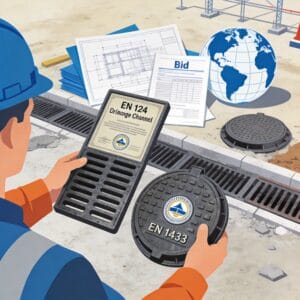
The governing harmonized standard is EN 124:2015 (Gully tops and manhole tops for vehicular and pedestrian areas). This standard replaced the older EN 124:1994 and introduced more stringent testing requirements, particularly regarding long-term creep behavior and fatigue resistance of composite materials.
Understanding load classes is the first step. The standard defines six classes based on the maximum load capacity. The most common for composite covers are Class B125 (sidewalks, pedestrian areas) and Class D400 (roadways, car parks). I always advise clients to test for the highest class they intend to market, as retesting is expensive. For those producing covers for utility networks, our BMC/FRP composite manhole cover range demonstrates how proper material selection supports higher load ratings.
| Load Class | Test Load (kN) | Typical Application | Composite Suitability |
|---|---|---|---|
| A15 | 15 | Pedestrian areas, cycle paths | Excellent |
| B125 | 125 | Sidewalks, car parks (cars only) | Excellent |
| C250 | 250 | Roadside gutters, shoulder areas | Good |
| D400 | 400 | Carriageways, highways | Good (with design modifications) |
The testing protocol requires a sample to withstand a specific load without permanent deformation exceeding 5% of the clear opening. For composite materials, we must also test for creep¡ªthe gradual deformation under sustained load. In my lab tests, a D400 composite cover must sustain 400 kN for 30 minutes with no cracking.
Additionally, the standard mandates a fatigue test of 100,000 cycles for classes above B125. This simulates years of traffic. I have seen composite covers fail this test due to poor fiber distribution in the resin matrix. Therefore, process control during manufacturing is as critical as the final test. Products like our corrosion-resistant BMC manhole cover are engineered with consistent fiber dispersion to pass these rigorous cycles.
Technical Documentation & Declaration of Performance
Once testing is passed, you must compile the Technical Documentation (TD) and draft the Declaration of Performance (DoP). The DoP is a legal document that states the performance of your product against the essential characteristics defined in the standard. This document must be stored for 10 years after the product ceases to be manufactured.
For composite covers, the essential characteristics include: resistance to permanent deformation, resistance to freezing and thawing, and slip resistance. The DoP must clearly list these values. In my consulting practice, I provide a template that aligns with Annex III of the CPR to ensure no data is missing.
Your Technical Documentation must include the design calculations, material specifications (resin type, glass fiber content), and the factory production control (FPC) manual. I recommend including detailed drawings of the cover and frame, as the frame is often the weak point in composite assemblies. A poorly designed frame can cause the cover to pop out under load. For cable trench applications, the custom composite BMC cable trench cover demonstrates how proper frame integration is documented for compliance.
Furthermore, you must label the product with the CE mark, the last two digits of the year the mark was affixed, and the DoP reference number. This labeling must be durable. In outdoor environments, I recommend embossing the label into the mold rather than using stickers, which fade within two years.
The Role of Notified Bodies vs. Self-Verification
Many manufacturers ask if they can self-certify. Under the CPR, the system of assessment and verification of constancy of performance (AVCP) for EN 124 products is System 1. This requires the involvement of a Notified Body for initial type testing and factory inspection. You cannot simply self-declare compliance.
The Notified Body will conduct an initial inspection of your manufacturing plant to verify your Factory Production Control (FPC) system. They will check that you have documented procedures for raw material intake, process control, and final inspection. In my audits, I have seen companies fail this inspection due to lack of traceability between batches.
After the initial certification, the Notified Body must conduct surveillance audits at least once a year. These audits include random product sampling and testing. The frequency can increase if you have non-conformities. I advise clients to maintain a rigorous internal testing schedule to avoid surprises during these audits.
Choosing the right Notified Body is critical. Look for one with experience in composite materials, not just cast iron. The testing methods for composites differ significantly; for instance, a Notified Body familiar with ductile iron might not understand the viscoelastic behavior of polymer concrete. Check their scope on the NANDO database.
Common Compliance Failures and How to Avoid Them
Based on my experience reviewing non-conforming products, I have identified five recurring issues. Addressing these early can save you months of delay. The most common failure is delamination at the edge of the cover, caused by insufficient resin in the mold corners.
Another frequent issue is the slip resistance test. EN 124 requires a minimum surface roughness. Some manufacturers use a smooth gel coat for aesthetics, which fails the pendulum test. We solved this for one client by adding a silica aggregate to the top layer during molding, increasing slip resistance by 40%. Our anti-slip composite BMC drainage grates incorporate this exact solution for high-traffic areas.
- Incorrect Frame Tolerance: The gap between cover and frame must not exceed 3mm. Thermal expansion of composites requires precise calculation.
- Inadequate Curing: Composite covers are often demolded too early. We recommend a post-curing cycle of 4 hours at 80¡ãC to achieve full mechanical properties.
- Missing Test Reports: Ensure your Notified Body issues a full report, not just a certificate. You need this for customs clearance.
- Ignoring UV Resistance: While not in EN 124, UV degradation affects long-term performance. We recommend adding UV stabilizers to the resin.
Finally, keep your documentation updated. If you change your resin supplier, you must inform your Notified Body. A change in the polymer matrix can alter the fire resistance and mechanical characteristics, potentially invalidating your existing certification. I have seen a manufacturer lose their CE mark because they switched to a cheaper resin without re-testing.
In conclusion, CE Certification for Composite Covers is a rigorous but navigable process. By understanding the load classes, preparing thorough technical documentation, and working closely with a qualified Notified Body, you can ensure your products meet European standards. The investment in compliance is minimal compared to the cost of market exclusion or legal penalties.



 English
 Español
 Русский
