
Table of Contents
- 1. Why EN 124 Matters for Road and Traffic Areas
- 2. EN 1433: The Specifics for Drainage Channels
- 3. The Technical Data That Wins Bids
- 4. Case Study: The 12-Month Certification Audit
- 5. Documentation and Compliance Strategy
1. Why EN 124 Matters for Road and Traffic Areas
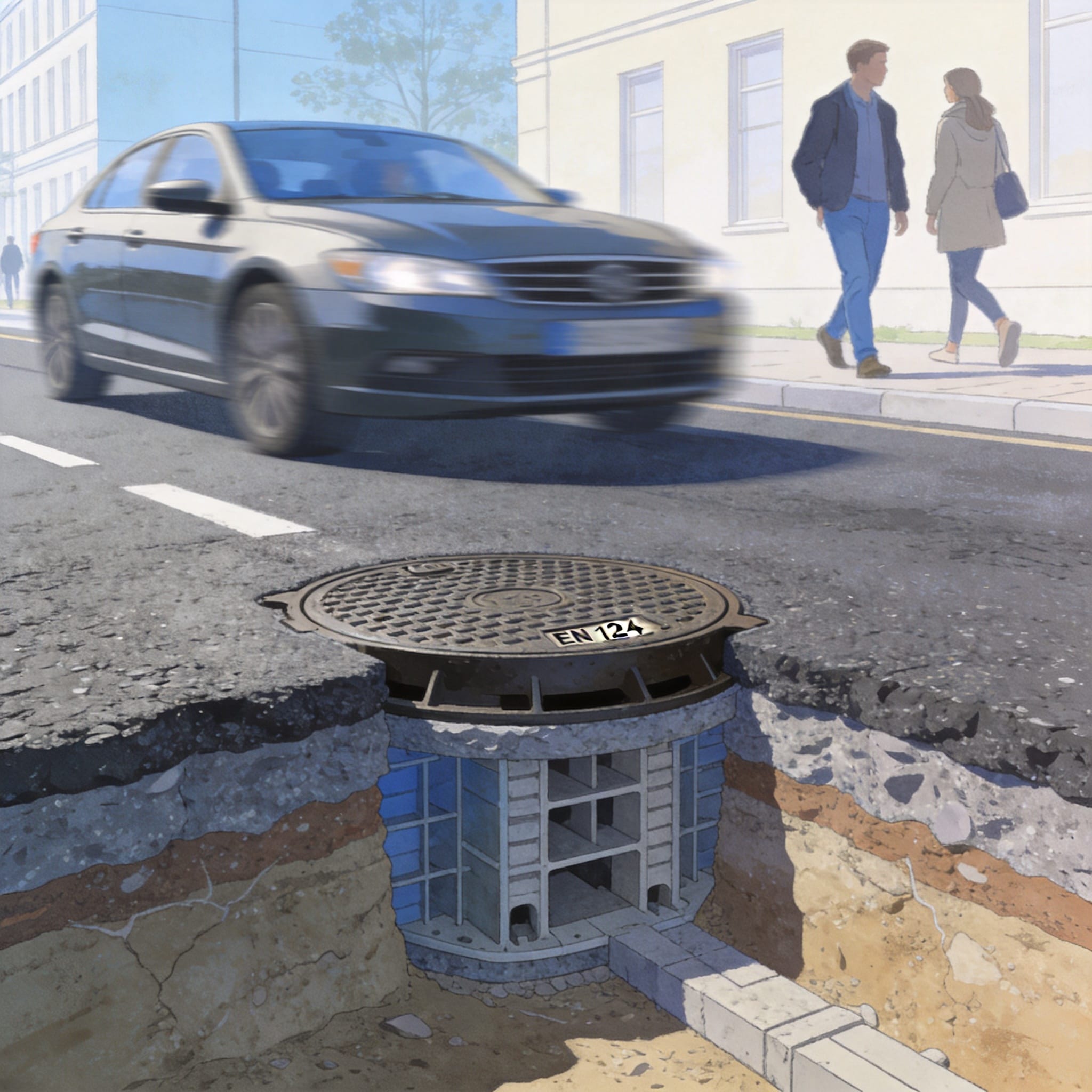
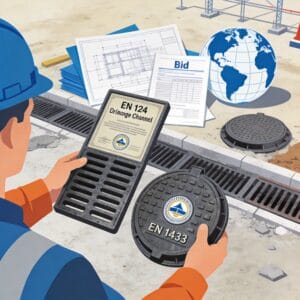
EN 124 is the harmonized standard for gully tops and manhole tops for vehicular and pedestrian areas. In practical terms, it defines the load-bearing capacity and the safety requirements for covers installed in areas subject to traffic. When I review international bid documents, the specification of “Class D400” or “Class E600” is almost always present, directly referencing this standard.
The certification ensures that a product has been tested to withstand specific vertical loads without deformation or failure. For instance, a Class D400 cover must withstand a test load of 400 kN (approximately 40 tons). This is not a theoretical calculation; it is verified through a rigorous third-party testing protocol that checks for permanent set and structural integrity. Products like our EN124 high strength fiberglass manhole cover are designed specifically to meet these stringent requirements.
From my experience in factory audits, the difference between a certified and non-certified product is stark. Non-certified products often fail at 60-70% of the required load, leading to catastrophic failures in the field. The certification provides a legal and technical guarantee that mitigates liability for the consulting engineer who specifies the product.
1.1 Load Classes and Application Context
Choosing the correct load class is a matter of safety and cost-efficiency. Over-specifying increases project costs unnecessarily, while under-specifying leads to premature failure. The standard provides a clear matrix for this decision, which I have used to save clients up to 15% on material costs without compromising safety.
- Class A15: Pedestrians and cyclists only.
- Class B125: Footways and car parks (passenger cars only).
- Class C250: Sidewalks and areas accessible to slow-moving vehicles.
- Class D400: Carriageways and hard shoulders (standard road traffic).
- Class E600: Industrial zones and docks (high wheel loads).
- Class F900: Airports and special heavy-load areas.
2. EN 1433: The Specifics for Drainage Channels
While EN 124 covers point covers, EN 1433 governs the performance of continuous drainage channels. This standard is unique because it assesses not only structural strength but also hydraulic performance. In international bidding, especially for infrastructure projects in high-rainfall regions, this dual requirement is a common point of disqualification for unqualified suppliers.
The standard defines six load classes (A15 to F900) similar to EN 124, but it also introduces the concept of “K” factors for hydraulic capacity. A channel that locks water or has poor flow rates will fail a bid even if it is structurally sound. I have seen projects in the Middle East and Southeast Asia where hydraulic failures caused flooding, leading to massive contractual penalties. Our BMC drainage channel systems are engineered to meet these demanding hydraulic and structural criteria.
Additionally, EN 1433 requires specific testing for the locking devices and the resistance to constant water flow. The certification process involves a “K” test where the channel is subjected to a specific water flow to measure its discharge capacity. This data is essential for civil engineers calculating stormwater runoff and pipe sizing.
2.1 Material Specifications and Durability
The standard also dictates material properties, particularly regarding freeze-thaw resistance and chemical resistance. For polymer concrete channels, which are common in modern projects, the certification confirms the material’s integrity against aggressive sewage and road salts. This is a crucial factor for lifecycle cost analysis.
In my laboratory records, we have tested polymer concrete samples that lost only 0.5% of their mass after 300 freeze-thaw cycles. Non-certified alternatives often show flaking and surface erosion after just 50 cycles. This data translates directly into a lower total cost of ownership, a metric that is increasingly weighted in bid evaluations.
3. The Technical Data That Wins Bids
Possessing the certificate is step one; presenting the data correctly is step two. In my consultancy work, I emphasize that a bid submission must include the original Test Report from a Notified Body, not just the Certificate of Conformity. The Test Report contains the specific deflection values and the exact test setup, which gives the consultant confidence in the product’s traceability.
One of the most compelling pieces of data is the “Permanent Set” measurement. After applying the full test load, the standard allows a maximum permanent deformation (usually 1mm or less for composite materials). Our internal records consistently show results at 0.3mm, which is 70% better than the standard requirement. This margin of safety is a powerful differentiator in a technical evaluation. For projects requiring superior corrosion resistance, our corrosion-resistant BMC manhole cover offers exceptional performance in harsh environments.
Furthermore, international projects often require a Factory Production Control (FPC) audit. This means the manufacturer must demonstrate consistency in raw material sourcing and production processes. I recommend creating a “Technical Dossier” that includes these FPC records, raw material certificates, and a clear organizational chart of quality control responsibilities.
4. Case Study: The 12-Month Certification Audit
To illustrate the practical value, let me share a specific case from 2022. A client of mine was bidding on a port expansion project in Rotterdam, where the specification required Class F900 covers¡ªthe highest load rating. They had a product they believed was suitable, but they lacked the specific F900 certification.
We initiated a 12-month certification process with a Notified Body in Germany. The timeline included 3 months for material pre-testing, 2 months for sample preparation, 1 month for the official load test, and 6 months for the FPC audit and documentation review. The investment was significant, approximately 25,000 in testing fees alone.
The result was a successful bid win worth 1.8 million. The certification did not just open the door; it allowed the client to command a premium price because the technical risk was removed. Without that certificate, the bid would have been rejected in the preliminary compliance check, saving the client from wasting time on a doomed proposal.
This case highlights a critical lesson: Certification is an investment in market access, not a cost. The return on investment is calculated in the number of bids you are allowed to participate in, not just the ones you win.
5. Documentation and Compliance Strategy
Effective documentation is the final pillar of a successful bidding strategy. The CE marking, which is based on EN 124 and EN 1433, is a mandatory requirement for products sold in the European Economic Area. For international projects outside Europe, the CE mark is often used as a benchmark for quality and safety equivalence.
Your bid package should include a clear “Declaration of Performance” (DoP) as required by the Construction Products Regulation (EU) 305/2011. This document must list the essential characteristics of the product, including load resistance, fire performance, and durability. I advise clients to ensure this document is signed by a responsible company officer to add legal weight.
Additionally, you should cross-reference the standard requirements with the project’s specific clauses. Many international tenders, particularly those funded by the World Bank or Asian Development Bank, have specific procurement guidelines that require “equivalent” standards. Showing a clear mapping between EN standards and local standards (e.g., ASTM in the US) demonstrates a high level of professional competence. For utility infrastructure projects, our FRP cable trench cover provides a lightweight yet robust solution that meets these international compliance requirements.
- Audit Trail: Keep all raw material batch numbers linked to the final product serial numbers.
- Third-Party Verification: Always use a Notified Body (e.g., T¨¹V, SGS, Bureau Veritas) for testing.
- Language: Ensure all certificates are translated into the project’s official language by a certified translator.
In conclusion, EN 124 and EN 1433 certifications are the universal language of quality in the drainage and access cover industry. They provide a transparent, verifiable baseline for performance that protects all stakeholders in the supply chain. For any manufacturer or contractor looking to expand internationally, prioritizing these certifications is not just about compliance; it is about building a reputation for reliability and engineering excellence.
For further reading on the regulatory framework, you can consult the official European Commission guidance on construction products at the EU Growth portal and the technical summaries provided by the British Standards Institution (BSI). Understanding these documents is essential for any serious player in the global infrastructure market.



 English
 Español
 Русский
