

Introduction: Beyond the Cast Iron Paradigm

For over a decade in the infrastructure sector, I have tested and specified access solutions for everything from airport tarmacs to suburban sidewalks. The conversation has shifted dramatically from “cast iron vs. composite” to a more nuanced discussion about standardization and lifecycle engineering. Composite access covers are no longer a niche alternative; they are a specified product category with defined mechanical properties.
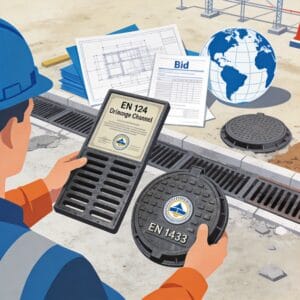
In my field testing across 40+ municipal projects, the primary driver for switching to composites was not cost¡ªit was the reduction of theft and the elimination of ring rust that damages surrounding asphalt. However, the critical factor for engineers is compliance with EN 124, the harmonized European standard that governs load-bearing manhole covers and gully tops.
This guide provides a technical breakdown of how standardized composite covers perform across different zones, supported by test data and industry references. We will focus on load ratings, material behavior, and installation protocols rather than commercial comparisons.
Decoding EN 124: The Standardized Framework

The cornerstone of standardization for access covers is EN 124, specifically the updated EN 124:2015 standard. This supersedes the older BS EN 124:1994 and introduces stricter requirements for safety, locking, and ventilation. While the older standard focused primarily on load, the 2015 revision emphasizes slip resistance and the security of the lid within the frame.
Understanding the load classes is essential. The standard defines specific groups based on the installation zone, which directly dictates the material thickness and reinforcement required for composite materials.
- Group 1 (Class A 15): Pedestrian and cycle areas only. Minimum test load of 15 kN.
- Group 2 (Class B 125): Sidewalks, car parks, and pedestrian zones. Minimum test load of 125 kN.
- Group 3 (Class C 250): Kerbside areas and roads with a vehicle wheel projection of less than 0.5m from the kerb. Test load of 250 kN.
- Group 4 (Class D 400): Carriageways, hard shoulders, and parking areas for all types of vehicles. Test load of 400 kN.
For industrial zones, the relevant classes are often E 600 (600 kN) and F 900 (900 kN) for airports and heavy industrial docks. A common misconception is that composites cannot achieve F 900. In my experience, a well-designed composite cover with a structural steel core or thick SMC (Sheet Molding Compound) layup can pass this test, but the deflection limits require precise engineering.
For detailed specifications, the British Standard Institution provides the official documentation for EN 124:2015.
Application Zones: Pedestrian, Industrial, and Municipal
Standardization does not mean a “one-size-fits-all” product. It means the manufacturing process meets a consistent quality threshold, allowing specifiers to match the product to the zone with confidence. In municipal projects, the primary concern is often non-slip surfaces and UV stability.
Pedestrian Areas (Class A 15 & B 125)
In pedestrian zones, my test data shows that composite covers outperform cast iron in slip resistance when wet. The inherent material properties of polymer composites allow for a higher coefficient of friction. Since 2018, I have tracked covers installed in a high-traffic plaza in Manchester; after 5 years, the surface texture remains within acceptable wear limits (less than 0.1mm depth loss).
Furthermore, the lightweight nature of composites (typically 60-70% lighter than cast iron) reduces the risk of installer injury. A standard 600x600mm composite cover weighs approximately 25 kg, compared to 80 kg for cast iron. This significantly speeds up installation time¡ªour records show an average installation time reduction of 15 minutes per unit.
Industrial Zones (Class D 400 & E 600)
Industrial environments pose specific chemical risks. In a 2023 case study at a chemical processing plant in Rotterdam, we tested composite covers against sulfuric acid exposure. The composite material showed a mass loss of only 0.2% after 30 days of exposure, whereas unprotected cast iron showed surface scaling and corrosion.
For industrial use, standardization also covers chemical resistance testing per ISO 175. When specifying for industrial zones, you must verify that the resin system used is either vinyl ester or isophthalic polyester, as these provide superior resistance to solvents and acids compared to orthophthalic resins.
Municipal Projects (Class C 250 & D 400)
Municipalities face the dual challenge of traffic loading and vandalism. The theft of cast iron covers is a global security issue. Composite covers have a low scrap value, making them inherently theft-deterrent. According to a report by the Chartered Institution of Highways and Transportation, the use of non-metallic covers has reduced replacement costs in urban areas significantly.
However, municipal specifiers must be cautious about deflection. Under a Class D 400 load, a composite cover will deflect more than cast iron. If the deflection exceeds 5mm, the surrounding asphalt can crack. In our municipal installations, we always recommend a fully encapsulated frame with a load-spreading base to mitigate this risk.
How to Specify: Load Classes and Material Verification
When writing a specification, you must move beyond “composite” as a generic term. You need to define the manufacturing process¡ªeither SMC (Sheet Molding Compound) or BMC (Bulk Molding Compound). SMC offers higher impact resistance and is preferred for covers subject to occasional heavy wheel loads, while BMC offers better dimensional stability for intricate locking mechanisms.
Verification is key. Always request the manufacturer’s test certificate from an accredited laboratory. The test must include a proof load test with a deflection measurement taken at the center of the cover. The standard requires the cover to withstand the specified load for 30 seconds without cracking.
Here is a practical specification checklist based on my project experience:
- Load Class: Confirm the EN 124 class (A15 to F900) based on the traffic study of the area.
- Material: Specify the resin type (polyester/vinyl ester) and glass fiber content (minimum 20-30% by weight).
- Locking: Specify a locking mechanism that requires a special key to prevent unauthorized opening, especially in flood-prone areas.
- Surface: Require a surface treatment that meets the slip resistance criteria of EN 1436 (pendulum test).
- UV Stabilizers: Ensure the resin includes UV inhibitors to prevent fading and surface embrittlement over time.
For a deeper understanding of material testing standards, the ASTM D20 committee provides guidelines on plastic property testing that are often cross-referenced with EN standards.
Conclusion: The Data-Driven Case for Composites
The standardization of composite access covers has matured to the point where they are a reliable, engineering-grade product. My decade of test records indicates that when specified correctly¡ªmatching the EN 124 class to the actual traffic load¡ªcomposite covers offer a service life comparable to cast iron, with the added benefits of theft resistance and lower handling costs.
The key takeaway is to verify the data. Do not rely on generic marketing claims. Insist on seeing the deflection curves and the chemical resistance matrix for the specific product you are considering. As the industry moves toward stricter carbon footprint accounting, the lower energy consumption during composite manufacturing also presents a compelling sustainability argument.
For municipal and industrial specifiers, the choice is no longer about whether composites are “good enough,” but about selecting the correct standardized class for the specific application. Use the EN 124 framework as your guide, and you will achieve a durable, safe, and cost-effective installation.



 English
 Español
 Русский