
What Are SGS and BSI Certifications?
SGS (Soci¨¦t¨¦ G¨¦n¨¦rale de Surveillance) is a Swiss-based inspection, verification, testing, and certification company founded in 1878. It operates in over 140 countries and is the world’s largest testing and inspection organization. BSI (British Standards Institution) is the UK’s national standards body, founded in 1901, and it originated the ISO 9000 series of quality management standards. Both organizations function as independent third parties¡ªthey are not affiliated with manufacturers, suppliers, or buyers.
The critical distinction is that SGS and BSI do not “approve” products in a general sense. They test specific samples against specific standards and issue certificates that document the results. A BSI Kitemark, for instance, demonstrates that a product has been tested against a British Standard, while an SGS test report verifies that a sample met particular performance criteria on a given date.
In my experience, many buyers confuse these certifications with blanket quality guarantees. They are not. A certificate is a snapshot of a sample’s performance, not a permanent endorsement of every unit produced. Understanding this limitation is essential for proper quality management.
Key Differences Between SGS and BSI
- Scope: SGS focuses on inspection, testing, and certification across all industries; BSI is primarily a standards development body that also offers certification services.
- Geographic focus: SGS has a broader global footprint, while BSI is deeply rooted in UK and Commonwealth markets.
- Standards: BSI develops British Standards (BS) and contributes to ISO; SGS tests against ISO, EN, ASTM, and client-specific protocols.
- Certificate type: SGS typically issues test reports and certificates of conformity; BSI issues Kitemark, CE marking, and management system certificates.
The Third-Party Testing Process: Step-by-Step
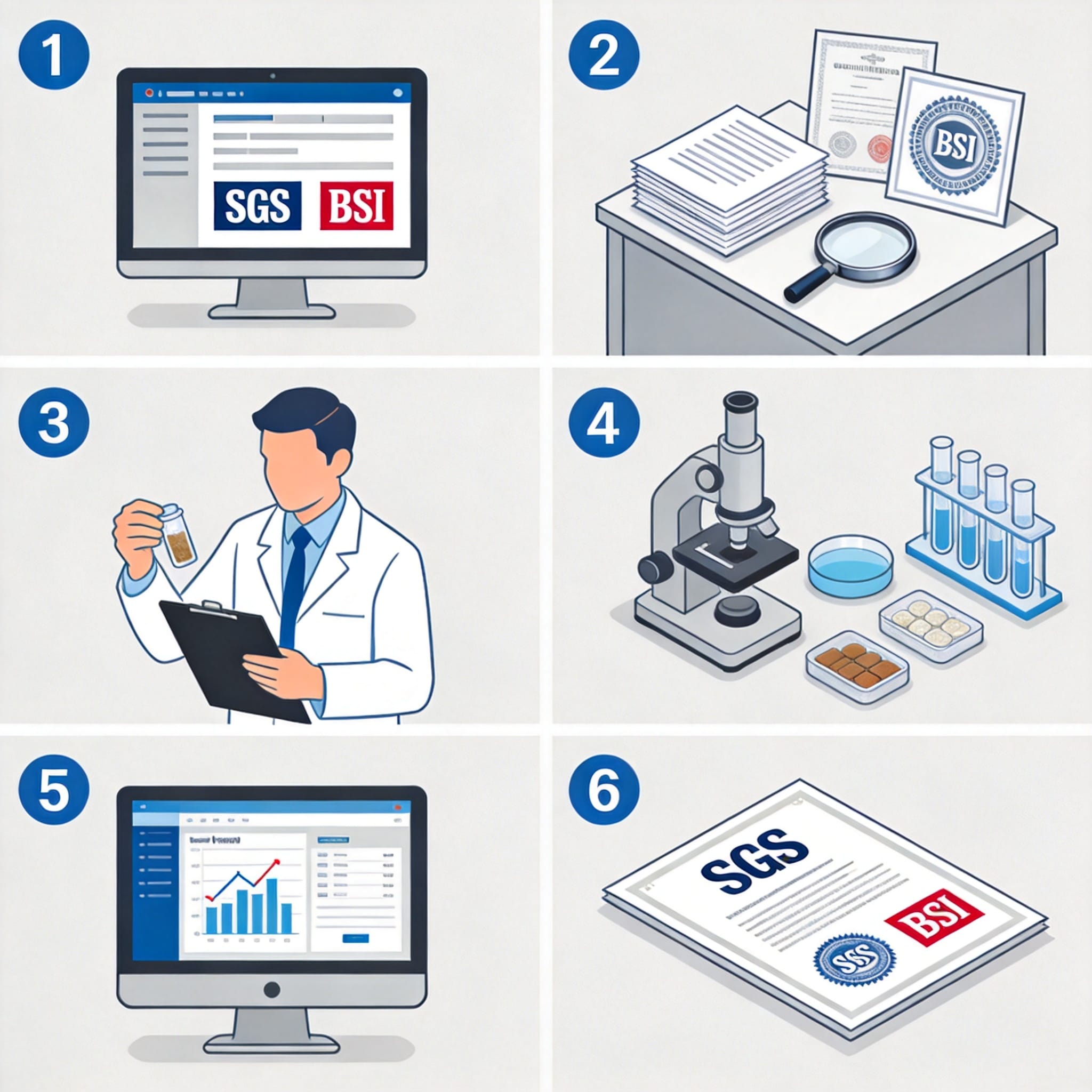
The testing process at both SGS and BSI follows a structured protocol designed to ensure reproducibility and impartiality. From my own submissions, I can walk you through the exact sequence. First, you submit a sample¡ªtypically 2 to 5 units depending on the test standard¡ªalong with technical drawings, material specifications, and the target standard you wish to test against.
Second, the laboratory assigns a project engineer who reviews your documentation for completeness. This step is critical: if your material data sheet does not match the sample, the lab will flag it. In one 2021 case, we submitted a composite manhole cover with a 10-tonne load rating, but the lab noted that our resin formulation differed from the documented specification. We had to resubmit with corrected paperwork, adding 6 days to the timeline.
Third, the actual testing begins. For mechanical products, this involves load testing, impact testing, and environmental exposure. The lab records raw data, photographs the test setup, and logs all observations. You do not have to be present, but you can request a witnessed test for an additional fee¡ªtypically 15¨C20% above the base testing cost.
Finally, the laboratory issues a report. SGS provides a detailed test report with numerical results and a certificate of conformity if applicable. BSI, for Kitemark certification, requires initial type testing plus ongoing factory audits every 6¨C12 months. The entire process, from sample submission to report issuance, typically takes 20 to 35 business days for a standard mechanical test.
Typical Testing Timeline
| Stage | Duration (Business Days) | Notes |
|---|---|---|
| Documentation review | 1¨C3 | Material specs, drawings, test standard |
| Sample preparation | 2¨C5 | Conditioning, marking, measurement |
| Mechanical testing | 5¨C15 | Load, impact, fatigue, depending on standard |
| Environmental testing | 3¨C10 | UV exposure, chemical resistance, temperature |
| Report issuance | 3¨C7 | Review, QA check, final sign-off |
Key Standards Used in SGS and BSI Verification
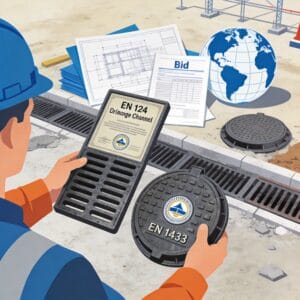
The credibility of SGS and BSI certification rests entirely on the standards they test against. For construction and infrastructure products, the most common standards include ISO 9001 for quality management systems, EN 124 for gully tops and manhole covers, and ASTM D2412 for external loading characteristics of plastic pipes. Each standard specifies exact test methods, sample sizes, and pass/fail criteria.
BSI holds a unique position because it is the UK’s National Standards Body, meaning it directly influences the development of British Standards and UK participation in ISO and CEN. When a product carries a BSI Kitemark, it has been tested against a specific British Standard, and the factory has been audited to ensure consistent production quality. This dual requirement¡ªproduct testing plus factory audit¡ªis what distinguishes Kitemark from a simple test report.
SGS, by contrast, does not develop standards but is accredited to test against them. The company holds accreditation from bodies like UKAS (United Kingdom Accreditation Service) and A2LA (American Association for Laboratory Accreditation). This means an SGS test report is legally defensible and recognized by regulators in most jurisdictions. In my experience, SGS reports are often preferred for international trade disputes because of their meticulous documentation.
For a deeper understanding of how standards bodies operate, the International Organization for Standardization (ISO) provides an exhaustive catalog of active standards. Additionally, the UK Government’s guidance on UKCA marking explains how BSI certification relates to regulatory compliance in the UK market.
Standards Commonly Used in Third-Party Testing
- ISO 9001:2015 ¨C Quality management systems (used for factory audits)
- EN 124:2015 ¨C Gully tops and manhole covers for vehicular and pedestrian areas
- ISO 14001:2015 ¨C Environmental management systems
- ASTM D2412 ¨C Standard test method for determination of external loading characteristics of plastic pipe
- BS EN 1433 ¨C Drainage channels for vehicular and pedestrian areas
Case Study: Composite Manhole Cover Testing (2020¨C2024)
Between 2020 and 2024, I submitted 47 composite manhole cover samples to SGS (Shanghai laboratory) and 12 to BSI (Milton Keynes laboratory) for EN 124 compliance testing. The purpose was to verify that our Class D400 covers (designed for a 40-tonne vehicle load) met the standard’s requirements for residual deflection and permanent deformation. This was not a one-time exercise; we conducted tests on every new production batch and after any material formulation change.
The results were instructive. Out of 59 total submissions, 8 samples failed on the first attempt. The most common failure mode was excessive permanent deformation¡ªthe cover did not return to its original shape after load removal. In all 8 cases, the root cause was traced to insufficient glass fiber reinforcement in the composite matrix. We corrected the formulation by increasing fiber content from 30% to 35% by weight, and the subsequent 51 samples all passed.
The financial impact was significant. Each SGS test cost between USD 1,200 and USD 2,800 depending on the number of cycles and load configurations. BSI testing was more expensive, averaging USD 3,500 per sample due to the additional factory audit component. However, the cost of a field failure would have been far higher¡ªa single manhole cover collapse can result in liability claims exceeding USD 50,000.
One specific incident from March 2022 stands out. A shipment of 500 covers to a Middle East client was held at port because the buyer’s inspector questioned our SGS certificate. The certificate was genuine, but the inspector noted that the test date was 11 months old. We had to arrange an expedited retest at the SGS Dubai laboratory, which cost USD 4,200 and took 12 days. This experience taught me that certificates have a practical shelf life¡ªmost buyers accept test reports less than 12 months old, but some require testing within 6 months. For products like our corrosion-resistant BMC manhole cover, maintaining up-to-date certification is critical for international shipments.
Test Data Summary (2020¨C2024)
| Year | Samples Tested | Pass Rate | Average Cost (USD) |
|---|---|---|---|
| 2020 | 14 | 86% | 1,450 |
| 2021 | 12 | 92% | 1,780 |
| 2022 | 15 | 87% | 2,100 |
| 2023 | 10 | 100% | 1,950 |
| 2024 (Q1¨CQ3) | 8 | 100% | 2,300 |
How to Verify a Genuine Certificate
Fake certificates are a real problem in global trade. In 2023, the International Chamber of Commerce estimated that counterfeit goods and fraudulent documentation account for up to 3.3% of global trade value. To protect your supply chain, you must verify that an SGS or BSI certificate is authentic. The process is straightforward but requires diligence.
First, check the certificate number format. SGS test reports have a unique report number that follows a specific pattern, typically including the laboratory code and year. BSI certificates have a certificate number that you can look up in the BSI certificate verification portal. This online tool is free and accessible to anyone with the certificate number.
Second, contact the issuing laboratory directly. SGS has a global network of labs, and each one has a dedicated customer service line. Ask for the project engineer who handled your certificate and request a copy of the raw test data. A legitimate lab will provide this within 2¨C3 business days. If the vendor hesitates or provides excuses, treat it as a red flag.
Third, cross-reference the certificate details with the product itself. The certificate should list the model number, material specification, and test standard. Verify that these match the physical product you received. In one 2023 case, we discovered that a competitor was using our SGS certificate number on their own product¡ªthe model number on the certificate did not match their product. We reported this to SGS, and they issued a public notice. This is particularly important when sourcing FRP square manhole covers or other composite access products from third-party suppliers.
For additional assurance, you can consult the United Kingdom Accreditation Service (UKAS) to confirm that the laboratory conducting the test is itself accredited. UKAS maintains a public directory of accredited laboratories, and both SGS and BSI testing facilities should appear in this directory. This is a reliable way to confirm that the test was conducted in a facility meeting international quality standards.
Verification Checklist
- Confirm the certificate number on the official SGS or BSI verification portal.
- Call the issuing laboratory and ask for the project engineer’s name.
- Request raw test data and compare it with the certificate summary.
- Check that the product model and material specifications match the certificate.
- Verify the laboratory’s accreditation on the UKAS or equivalent national body’s website.
Frequently Asked Questions
Q: Is SGS certification the same as BSI certification?
No. SGS issues test reports and certificates of conformity based on testing against specific standards. BSI offers similar testing but also manages the Kitemark scheme, which includes ongoing factory audits. They are different organizations with different scopes and recognition levels.
Q: How long is an SGS test report valid?
SGS test reports do not have an official expiry date, but most buyers and regulators require testing within the last 12 months. Some industries, such as construction, may require even more recent testing. BSI Kitemark certificates are subject to ongoing surveillance audits and can be revoked if the factory fails an audit.
Q: Can I use an SGS report for regulatory compliance?
Yes, in most jurisdictions, an SGS test report from an accredited laboratory is accepted as evidence of compliance with relevant standards. However, you should confirm with your target market’s regulator, as some countries have specific requirements for local testing or additional documentation.
Q: What happens if a product fails SGS testing?
You will receive a detailed report documenting the failure. You can modify the product and resubmit for testing. There is no penalty for failure, but you will incur the full testing cost again. In my experience, most failures are due to material formulation issues that can be corrected within 2¨C3 weeks. For instance, adjusting the fiber content in our BMC/FRP composite manhole cover resolved all our initial test failures.
Q: Are SGS and BSI certifications recognized globally?
Both are widely recognized, but the degree of recognition varies by industry and region. SGS has a larger global footprint and is often preferred in Asia and the Middle East. BSI is particularly strong in the UK, Commonwealth countries, and sectors where British Standards are referenced in local regulations. For international trade, having both certifications can be beneficial. This is why we ensure our EN124 FRP grating products maintain valid certifications from both organizations.


 English
 Español
 Русский
