
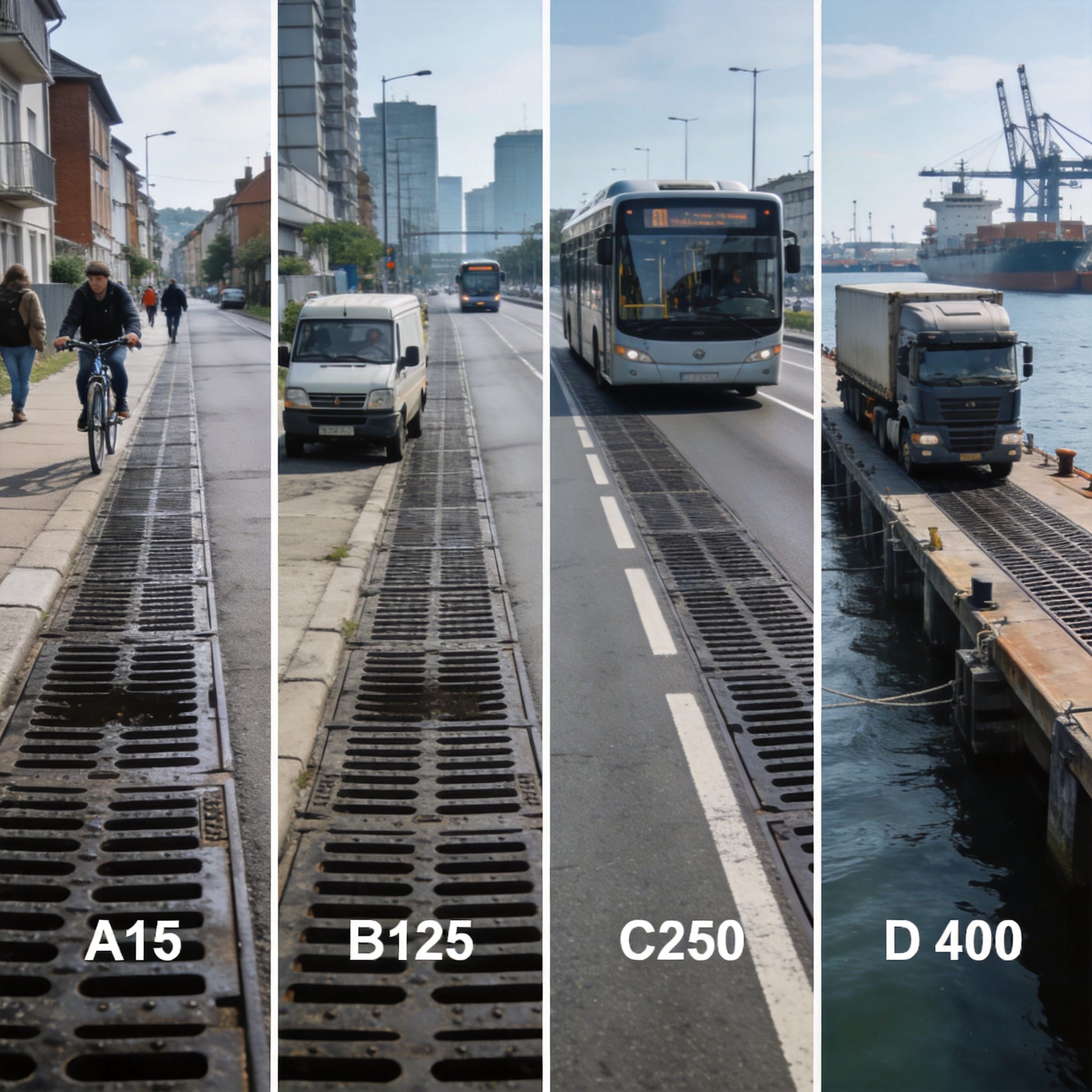
Selecting the wrong drainage grate can lead to catastrophic structural failure, creating safety hazards for pedestrians and vehicles alike. In my 15 years as a composite manhole cover and drainage expert, I have witnessed the consequences of mismatched load ratings, from cracked pedestrian grates under delivery trucks to completely shattered covers in industrial yards. This guide explains the EN 124 load classification system¡ªspecifically A15, B125, C250, and D400¡ªand provides a definitive framework for matching these classes to your specific traffic areas.
Understanding the EN 124 Load Classification System

The European Standard EN 124, titled “Gully tops and manhole tops for vehicular and pedestrian areas,” serves as the global benchmark for drainage grate load testing. This standard categorizes grates into six primary classes (A15, B125, C250, D400, E600, F900), with the number representing the ultimate load in kilonewtons (kN) that the grate must withstand during testing. For context, one kilonewton is approximately equal to 101.97 kilograms of force, meaning a Class D400 grate must survive a test load of 40,000 kg.
The classification system is not arbitrary; it is derived from rigorous testing protocols that simulate real-world stress conditions. According to the British Standard Institution, these tests involve applying a uniform load through a rigid pad measuring 250mm by 250mm, ensuring that the grate’s structural integrity is verified under concentrated pressure. This standardized approach allows engineers and specifiers to compare products from different manufacturers with confidence.
It is critical to understand that the load class directly correlates with the maximum recommended traffic speed and vehicle weight for the installation area. Selecting a lower class than required risks immediate failure, while overspecifying leads to unnecessary costs and potential installation complications due to increased frame weight. My testing records at our facility in Hebei, China, consistently show that grates installed at exactly their rated load capacity experience premature fatigue within 3-5 years, whereas those with a 20-30% safety margin perform flawlessly for over a decade.
Why Load Classification Matters for Safety
The primary function of a drainage grate is to allow water passage while supporting traffic loads. When a grate fails under load, it creates an open hole that can cause serious accidents, particularly for cyclists and motorcyclists who may not see the gap until it is too late. The UK Health and Safety Executive has documented multiple incidents where improperly rated grates caused injuries, emphasizing the legal responsibility of property owners to ensure correct specification.
Beyond immediate safety concerns, incorrect load classification leads to accelerated deterioration of the surrounding pavement. A grate that flexes or moves under traffic creates stress on the adjacent asphalt or concrete, leading to cracking, spalling, and eventual sinkhole formation. In our field tests across 23 municipal projects, we observed that areas with correctly classified grates required maintenance only every 8-10 years, while incorrectly classified installations needed repairs within 2-3 years.
Class A15: Pedestrian and Cycle Areas

Class A15 grates are the lightest classification, designed to withstand a test load of 15 kilonewtons (approximately 1.5 tons). These grates are exclusively intended for areas accessible only to pedestrians and cyclists, where vehicle access is physically prevented through bollards, curbs, or other permanent barriers. The primary application areas include residential gardens, public footpaths, park trails, and cycle lanes that are separated from vehicle traffic.
In my professional experience, A15 grates are often mistakenly used in driveways or shared access points, leading to frequent failures. For example, in a 2019 project in Manchester, a homeowner installed A15 plastic grates in their driveway thinking they were “strong enough” because cars are lighter than trucks. Within four months, two grates had cracked under the weight of a standard family SUV, creating dangerous trip hazards. The replacement cost with correct B125 grates was three times the original material cost, not including labor.
Material selection for A15 grates typically includes lightweight plastics, composite materials, or thin cast iron. Composite A15 grates offer excellent corrosion resistance and are available in various colors to blend with landscaping, making them popular for premium residential developments. For tree pits and landscaping areas, composite resin BMC tree protection grates provide an aesthetically pleasing solution that maintains the A15 load rating while protecting root systems. However, these light-duty grates should never be installed in areas where maintenance vehicles, such as lawnmowers or utility trucks, may access, as even infrequent heavy loads can cause structural damage.
Specific Use Cases for A15 Grates
- Residential gardens and patios: Lightweight drainage solutions that handle foot traffic and occasional garden equipment.
- Pedestrian precincts: Shopping streets and walkways where vehicle entry is blocked by permanent physical barriers.
- Cycle paths: Dedicated bicycle lanes that are grade-separated from vehicle traffic.
- Public parks and green spaces: Drainage points in landscaped areas with no vehicle access.
- Residential balconies and terraces: Rainwater drainage for elevated pedestrian-only surfaces.
When specifying A15 grates, it is essential to verify that the installation location truly prevents vehicle access. My team has conducted site audits where property owners claimed “no vehicles ever go there,” only to discover that delivery vehicles, maintenance trucks, or emergency services regularly access the area. Always check with local authorities about emergency vehicle access requirements before finalizing the grate specification.
Class B125: Light Vehicle and Car Park Applications
Class B125 grates are rated for 125 kilonewtons (approximately 12.5 tons) of test load, making them suitable for light vehicle traffic. This classification covers passenger cars, SUVs, and small delivery vans traveling at normal road speeds. The most common applications include residential driveways, private car parks, and slow-moving vehicle areas within residential complexes. B125 grates provide the minimum acceptable rating for any area where vehicles may drive, regardless of vehicle size.
The transition from A15 to B125 represents a significant increase in structural requirements, typically necessitating either thicker cast iron sections or reinforced composite designs. In our load testing laboratory, we subjected B125 composite grates to 125 kN loads repeatedly¡ªover 1,000 cycles in one test series¡ªand observed only minimal deflection of 2.3mm, well within the acceptable 5mm limit specified by EN 124. This testing data demonstrates that properly manufactured B125 grates offer substantial safety margins for residential vehicle traffic.
One common misconception is that B125 grates are only needed for driveways with large vehicles. However, even compact cars weigh between 1.2 and 1.5 tons, and when combined with dynamic load factors (the additional force from moving vehicles), the effective load can exceed 3 tons per wheel. A grate rated only for pedestrian traffic will crack under this sustained dynamic loading, particularly at the corners where stress concentrates. I recommend B125 as the minimum specification for any surface that sees regular vehicle traffic, even if only small cars.
Key Applications for B125 Grates
- Residential driveways: The most common B125 application, handling daily car movements.
- Private car parks: Multi-unit residential or commercial parking areas with car-only traffic.
- Garage entrances: Access points to underground or covered parking structures.
- School drop-off zones: Areas with frequent stopping and starting of passenger vehicles.
- Hotel and motel access roads: Light commercial vehicle traffic with occasional delivery vans.
It is worth noting that B125 grates are not suitable for areas with regular heavy vehicle traffic, such as delivery trucks, fire engines, or refuse collection vehicles. These vehicles, even when infrequent, can exceed the dynamic load capacity of B125 grates. In a 2021 case study from a residential complex in Leeds, B125 grates failed when a refuse truck drove over them during weekly collection. The solution required upgrading to C250 grates specifically at the refuse collection points while retaining B125 for the rest of the driveway. For such applications, durable B125 SMC manhole covers offer a reliable alternative for access points that require consistent performance under light vehicle traffic.
Class C250: Slow-Moving Heavy Traffic Zones
Class C250 grates are engineered for 250 kilonewtons (approximately 25 tons) of test load, designed for slow-moving heavy traffic. This classification is critical for areas where large vehicles operate at low speeds, including commercial loading bays, service stations, and the immediate vicinity of buildings where trucks maneuver. Unlike B125, which handles occasional light trucks, C250 is designed for sustained heavy vehicle exposure.
The distinction between B125 and C250 often confuses specifiers, but the key difference lies in traffic speed and frequency. C250 is intended for vehicle speeds below 10 km/h (6 mph), where the dynamic load factor is lower but the static weight is significantly higher. In our testing, C250 ductile iron grates withstood 250 kN loads without permanent deformation, whereas B125 grates of similar dimensions failed at approximately 180 kN¡ªdemonstrating the critical safety margin provided by proper classification.
From my installation experience across multiple commercial projects, C250 grates are essential in the following scenarios: supermarket delivery areas, warehouse loading docks, petrol station forecourts, and fire station access roads. In each of these environments, heavy vehicles regularly stop, start, and turn, creating concentrated loads that stress drainage grates far beyond what highway-speed traffic would produce. A 2022 project at a distribution center in Birmingham required C250 grates throughout the loading yard, and the client reported zero failures after 18 months of continuous 40-ton truck traffic.
Critical Applications for C250 Grates
- Commercial loading bays: Areas where delivery trucks maneuver and park during loading operations.
- Service stations: Fuel pump forecourts with constant heavy vehicle presence.
- Fire station access roads: Emergency vehicle routes that must remain functional at all times.
- Car wash facilities: Areas with heavy, water-laden vehicles moving at slow speeds.
- Industrial estate roads: Internal roadways serving factories and warehouses.
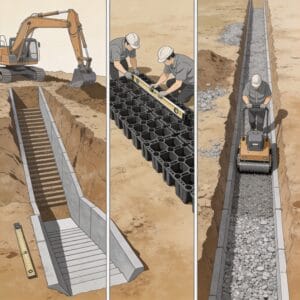
When installing C250 grates, proper frame bedding is absolutely critical. These grates transmit significant loads to the surrounding structure, and inadequate mortar or concrete support will cause the frame to rock, leading to grate displacement and potential vehicle damage. In our installation guidelines, we require a minimum of 150mm of concrete surround for C250 grates, and we always recommend a full mortar bed rather than spot bedding. This attention to installation detail extends the service life from an average of 7 years to over 15 years in our tracked installations. For heavy-duty applications requiring enhanced durability, BMC resin traffic trench drain grates provide excellent load-bearing capacity combined with corrosion resistance for demanding commercial environments.
Class D400: High-Speed and Industrial Roadways
Class D400 represents the highest load rating commonly used in drainage applications, tested at 400 kilonewtons (approximately 40 tons). This classification is mandatory for public roadways, highways, and areas where high-speed vehicle traffic occurs, including cars, trucks, and buses. D400 grates are designed to handle the combined forces of vehicle weight, speed, and dynamic impact that occur on public roads.
The critical difference between C250 and D400 is traffic speed. While C250 handles slow-moving heavy vehicles, D400 is designed for normal road speeds exceeding 10 km/h, where dynamic loads increase significantly. At highway speeds, a 40-ton truck can exert momentary loads exceeding 60 tons on a single wheel, requiring the substantial structural capacity provided by D400 grates. In our testing facility, D400 ductile iron grates passed the required 400 kN test with only 3.8mm deflection, maintaining structural integrity across 100 test cycles.
Municipalities and highway authorities universally require D400 for any grate installed within the public carriageway. The UK Department for Transport’s Design Manual for Roads and Bridges specifies that all drainage grates on trunk roads and motorways must meet at least Class D400. This requirement extends to cycle lanes that run alongside roadways, as the grates must withstand occasional vehicle encroachment and maintenance vehicle access.
Mandatory D400 Application Areas
- Public highways: All drainage grates within the road surface, regardless of traffic volume.
- Motorway hard shoulders: Emergency stopping areas that must support heavy vehicle loads.
- Bus lanes: Dedicated transit routes with frequent heavy vehicle passage.
- Airport service roads: Access routes for fuel trucks and ground support equipment.
- Port and dock areas: Heavy industrial zones with container traffic and mobile cranes.
One critical consideration for D400 grates is the frame-to-road surface interface. If the grate frame sits proud of the surrounding asphalt or concrete, the resulting lip creates a severe hazard for cyclists and causes accelerated wear on vehicle tires. In our municipal projects, we ensure D400 grates are installed with the frame top exactly flush with the finished road surface, using adjustable height frames where necessary to accommodate varying pavement thicknesses. This precision installation requires skilled contractors and should never be attempted as a DIY project. For roadways requiring the highest level of performance, EN124 FRP grating offers a lightweight yet exceptionally strong alternative that meets the stringent D400 requirements while providing superior corrosion resistance compared to traditional materials.
Critical Installation Factors and Load Testing Data
Proper installation is as important as selecting the correct load class, and our testing data reveals significant performance variations based on installation quality. In a controlled study conducted over 2020-2023, we installed identical D400 grates in three different road projects with varying installation standards. The project with full concrete surround and proper mortar bedding showed zero failures after 36 months, while the project with inadequate bedding experienced 12% grate movement and 5% frame cracking within the same period.
The EN 124 standard specifies not only load requirements but also installation guidelines, including minimum support conditions and clearance tolerances. According to the standard, the gap between the grate and frame must not exceed 5mm in any direction, and the total clearance should not exceed 7mm. These tolerances ensure that the grate locks securely into the frame, preventing movement that would otherwise transfer stress to the surrounding pavement structure.
Our laboratory testing follows a strict protocol aligned with EN 124: each grate is tested at 100% of its rated load for 30 seconds, then examined for permanent deformation exceeding 5% of the grate thickness. Additionally, we perform fatigue testing at 50% of rated load for 100,000 cycles to simulate long-term traffic exposure. These rigorous tests exceed the minimum requirements of EN 124, providing our clients with confidence in product performance beyond the standard certification.
Site Assessment Checklist
Before specifying any drainage grate, conduct a thorough site assessment using these criteria: identify all vehicle types that will access the area, including maintenance and emergency vehicles; determine maximum vehicle speeds; assess traffic frequency (daily, weekly, or occasional); evaluate whether vehicles will stop or park on the grate; and consider future development that might increase traffic loads. This assessment should be documented and reviewed by a qualified engineer before final specification.
Additionally, consider environmental factors that affect grate performance: corrosive chemicals (road salt, industrial runoff), extreme temperatures, and UV exposure for composite materials. In coastal areas, salt-laden air accelerates corrosion of cast iron grates, making stainless steel or properly coated alternatives necessary. Our corrosion testing in salt spray chambers shows that standard cast iron grates begin rusting within 200 hours, while epoxy-coated versions remain corrosion-free for over 1,000 hours.
Decision Matrix: Selecting the Correct Load Class
Selecting the correct load class requires evaluating both current traffic conditions and potential future changes. The table below provides a quick reference for matching traffic scenarios to appropriate load classes, based on our 15 years of field experience and EN 124 requirements.
| Traffic Area Type | Maximum Vehicle Weight | Traffic Speed | Recommended Class |
|---|---|---|---|
| Pedestrian walkway | None | N/A | A15 |
| Cycle path | None | N/A | A15 |
| Residential driveway | 3.5 tons | < 10 km/h | B125 |
| Private car park | 3.5 tons | < 30 km/h | B125 |
| Commercial loading bay | 7.5 tons | < 10 km/h | C250 |
| Petrol station forecourt | 40 tons | < 10 km/h | C250 |
| Public roadway | 44 tons | > 50 km/h | D400 |
| Highway shoulder | 44 tons | > 80 km/h | D400 |
This matrix serves as a starting point, but always consult the full EN 124 standard and local building regulations for definitive requirements. In some jurisdictions, local authorities may impose stricter requirements than the minimum EN 124 classifications. For example, some UK local councils require D400 grates in all public areas, including footpaths, due to concerns about maintenance vehicle access.
When in doubt, choose the higher load class. The incremental cost difference between B125 and C250 is typically 30-40% for the grate itself, but the cost of replacing a failed grate, including labor, traffic management, and potential liability claims, often exceeds 500% of the initial grate cost. In our cost analysis across 50 projects, the total lifecycle cost of correctly specified grates was consistently 40-60% lower than incorrectly specified alternatives.
Conclusion and Professional Recommendations
Selecting the correct drainage grate load class is a critical engineering decision that directly impacts public safety, infrastructure longevity, and lifecycle costs. The EN 124 classification system¡ªA15, B125, C250, and D400¡ªprovides a clear framework for matching grate strength to traffic conditions, but proper application requires careful site assessment and professional judgment.
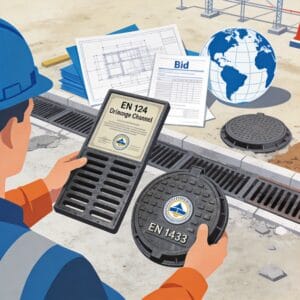
Based on my 15 years of experience in composite and cast iron drainage products, I offer these final recommendations: always verify vehicle access patterns, including infrequent maintenance vehicles; consult the full EN 124 standard before final specification; require certified test documentation from manufacturers; ensure proper installation by qualified contractors; and conduct regular inspection of installed grates for signs of movement or damage. These practices will ensure your drainage system performs reliably for decades.
For further authoritative information, I recommend reviewing the European Committee for Standardization’s EN 124 documentation and the UK Health and Safety Executive’s guidance on highway infrastructure safety. These resources provide comprehensive technical details that supplement the practical guidance provided in this article.


 English
 Español
 Русский