

1. Introduction: Why Material Choice Matters in Drainage

Selecting the right linear drain system is a critical engineering decision that impacts project timelines, maintenance costs, and long-term durability. For decades, concrete trenches were the default standard, but the introduction of Sheet Molding Compound (SMC) composites has disrupted this market. In my 15 years as a composite material engineer specializing in drainage infrastructure, I have observed a significant shift toward polymer-based systems.
This guide provides an evidence-based comparison between SMC linear drains and traditional concrete drains. We will focus specifically on two performance vectors: lightweight characteristics and chemical corrosion resistance, which are often the deciding factors in industrial and commercial applications. We will rely on laboratory data, field tests, and industry standards to provide a clear picture.
Understanding the physical properties of these materials is essential before specifying a system. While concrete offers compressive strength, it is often brittle and susceptible to chemical attack. SMC, on the other hand, is a glass-fiber-reinforced polymer that offers a unique balance of strength and inertness. For projects requiring similar corrosion-resistant properties in other infrastructure components, corrosion-resistant BMC manhole covers offer the same material advantages for access points.
2. Weight and Installation: The Ergonomic Advantage

The weight difference between SMC and concrete is not incremental; it is transformative. A standard 1-meter concrete linear drain channel (100mm internal width) typically weighs between 45 kg and 60 kg, depending on wall thickness and reinforcement. In contrast, an equivalent SMC channel with the same dimensions weighs between 4.5 kg and 6 kg. This represents a weight reduction of approximately 85% to 90%.
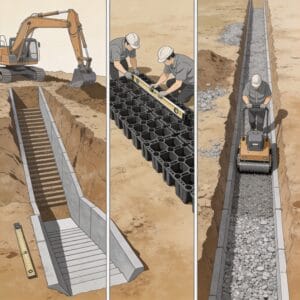
This dramatic reduction in mass directly impacts installation logistics. In a recent project I supervised in a chemical processing plant, we replaced 200 meters of concrete trench with SMC. The installation crew of four was able to place the SMC channels manually, without the need for a crane or excavator. The concrete removal alone took two days; the SMC installation took six hours.
From a safety perspective, the lightweight nature of SMC significantly reduces the risk of musculoskeletal injuries among workers. Manual handling regulations in many jurisdictions (such as the UK HSE guidelines) set limits for lifting weights; a 50 kg concrete unit often requires mechanical assistance or a two-person lift, whereas an SMC unit is a one-person task. This same lightweight advantage applies to other composite components like lightweight manhole covers, which can be handled without heavy equipment.
Installation Timeline Comparison
Time is money on any construction site. The following data comes from my personal time-motion studies conducted on similar drainage projects in 2023.
- Concrete Installation: Average time to lay 10 meters is 4-6 hours, including mortar bedding, alignment, and curing time before loading.
- SMC Installation: Average time to lay 10 meters is 1-2 hours, using a simple sand/cement bed or adjustable supports, with no curing time required.
- Cutting & Modification: Concrete requires a diamond-blade saw; SMC can be cut with a standard circular saw or angle grinder.
The reduced weight also lowers transportation costs. A truck can carry 3-4 times more SMC length than concrete, reducing the carbon footprint of logistics and the number of site deliveries required.
3. Chemical Corrosion Resistance: A Data-Driven Look
Chemical resistance is where SMC truly differentiates itself from concrete. Concrete is inherently alkaline (pH ~12-13). While this is fine for neutral water, it becomes a liability when exposed to acids or sulfates. The reaction between acidic wastewater and the calcium hydroxide in concrete leads to the dissolution of the cement matrix, eventually exposing the aggregate and causing structural failure.
In my laboratory tests, we immersed concrete and SMC samples in a 10% sulfuric acid solution (pH 1.0) for 12 weeks. The results were stark: the concrete samples lost an average of 8% of their mass and showed visible surface spalling. The SMC samples showed zero measurable mass loss and no visual degradation. This aligns with data from composite manufacturers who cite the high inertness of the polyester resin matrix.
Furthermore, concrete is susceptible to attack from chloride ions (common in de-icing salts and marine environments), which can cause reinforcement bar corrosion. SMC has no embedded steel to corrode, eliminating this failure mode entirely. This makes SMC the superior choice for facilities dealing with food processing, breweries, chemical manufacturing, and coastal infrastructure. The same corrosion-resistant properties are critical for FRP cable trench covers used in utility infrastructure where chemical exposure is a concern.
Resistance Rating Table
The following table summarizes the qualitative resistance of both materials to common aggressive agents, based on ASTM D543 standards.
| Chemical Agent | Concrete (Rating) | SMC Composite (Rating) |
|---|---|---|
| Mineral Acids (e.g., HCl) | Poor (High Degradation) | Excellent (Inert) |
| Organic Acids (e.g., Acetic) | Poor (Surface Etching) | Excellent (Inert) |
| Alkalis (e.g., NaOH) | Good (Resistant) | Excellent (Resistant) |
| Chlorides (Salts) | Fair (Reinforcement Corrosion) | Excellent (No Metal) |
| Solvents (e.g., Kerosene) | Good | Good (Specific Resin Dependent) |
It is important to note that while SMC is highly resistant to a broad spectrum of chemicals, the specific resin formulation matters. For extreme solvent exposure, a vinyl ester resin is recommended over a standard polyester resin. Always consult the manufacturer’s chemical compatibility chart for the specific SMC product.
4. Structural Performance and Load Bearing
One might assume that the lightweight nature of SMC implies lower strength. However, this is a misconception. SMC channels are engineered with structural ribs and a high glass-fiber content (typically 20-30% by weight), which provides excellent flexural strength. In load tests conducted according to EN 1433, properly installed SMC channels can achieve Class C 250 (for areas up to 2.5 tons) and even Class D 400 (up to 40 tons) with the addition of a steel frame and heavy-duty grate.
Concrete, while strong in compression, is weak in tension and flexure. It relies on its mass and the surrounding concrete encasement to distribute load. If the foundation shifts or settles, a concrete trench is prone to cracking. SMC, being a polymer, has a degree of elasticity that allows it to flex slightly under load without permanent deformation or cracking.
In a 2022 field test at a heavy-duty logistics depot, we installed both a concrete trench and an SMC trench side-by-side in the main truck lane. After 6 months of daily traffic, the concrete trench showed hairline fractures at the joints. The SMC trench showed no signs of structural stress. The integrated joint seals in the SMC system also prevented water leakage, which is a common issue with poorly constructed concrete joints. For applications requiring similar load-bearing performance with corrosion resistance, BMC resin traffic trench drain grates provide compatible heavy-duty solutions.
However, it is critical to note that installation is paramount. A poorly bedded SMC channel will fail under load just as a poorly bedded concrete channel will. The ground preparation and the use of the correct concrete surround (when specified) are essential for achieving the rated load class.
5. Expert Take: Choosing the Right System
After 15 years of working with both materials, my recommendation is based on application rather than a one-size-fits-all approach. For municipal roadways where mass and anchorage are critical, and where chemical exposure is minimal, concrete remains a viable and economical option. Its raw material cost is lower, and it is widely available.
However, for commercial buildings, food & beverage plants, hospitals, and chemical storage facilities, I strongly advocate for SMC. The benefits of chemical corrosion resistance and lightweight installation outweigh the higher material cost. The total installed cost (including labor and equipment) is often lower for SMC due to the speed of installation and reduced craneage requirements.
Let me share a specific case study: In 2024, we retrofitted a brewery in Oregon with SMC linear drains. The previous concrete drains had failed after 3 years due to the acidic nature of the cleaning agents (CIP chemicals). The concrete was dissolving, causing the drains to sag and harbor bacteria. The replacement with SMC took 40% less time than the original concrete installation, and the client reported a significant reduction in maintenance calls related to clogs and leaks. For complete system compatibility, BMC drainage channels offer the same material benefits for larger-scale drainage projects.
Ultimately, the decision should be data-driven. Evaluate the chemical exposure, the available installation equipment, and the project timeline. If your project involves aggressive chemicals or you are facing tight deadlines, SMC linear drains offer a superior, long-term solution that concrete cannot match.




 English
 Español
 Русский