
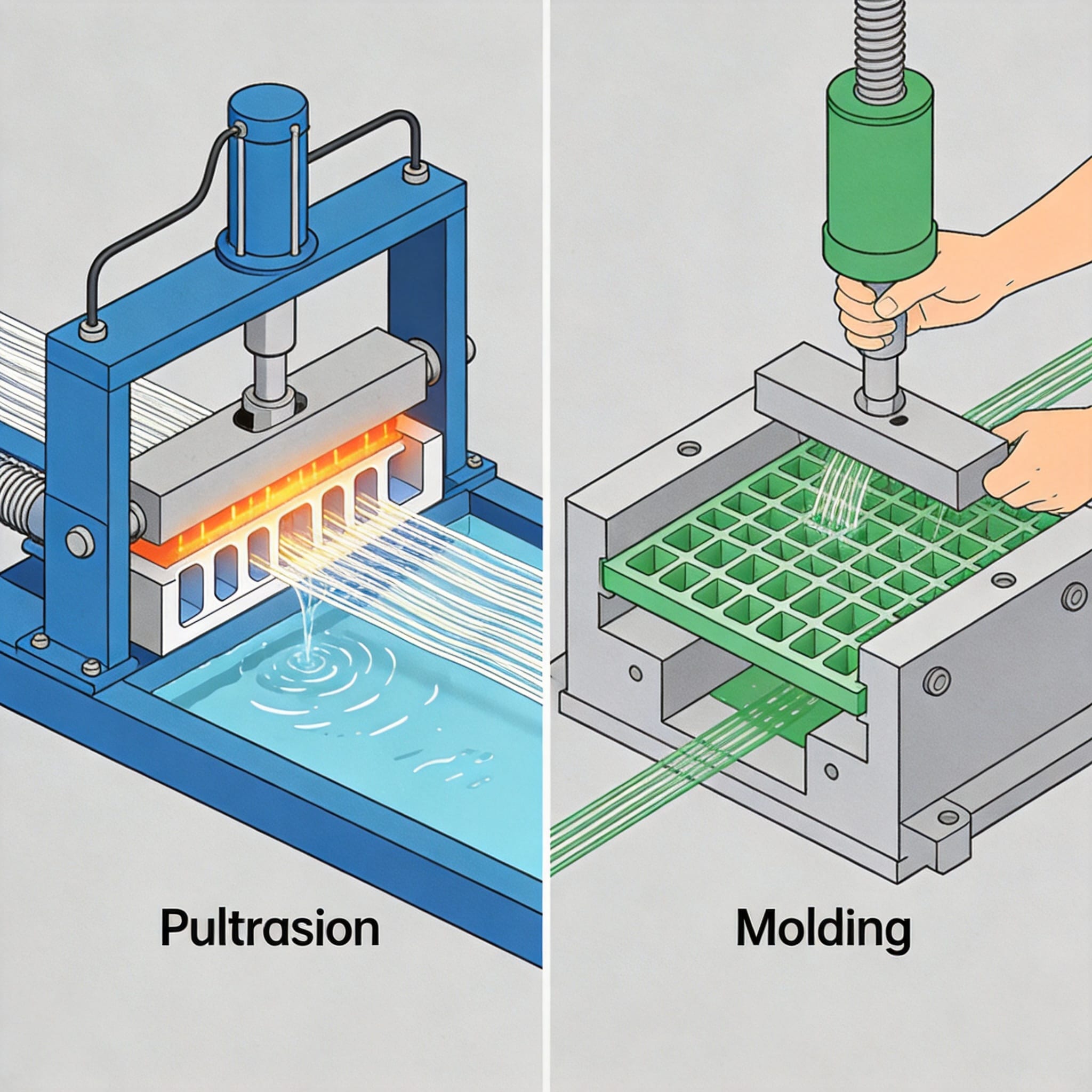
Choosing between pultruded and molded FRP grating is not a matter of preference; it is an engineering decision based on load requirements, environmental exposure, and lifecycle costs. In my 15 years of testing composite materials in the field, I have seen expensive specification failures occur simply because the specifier did not understand the anisotropic nature of pultruded profiles versus the isotropic nature of molded panels. This guide compares the two manufacturing processes using first-hand production data and third-party ASTM testing.
1. The Core Differences in Manufacturing Physics
The pultrusion process is continuous and automated. Roving glass fibers are pulled through a resin bath and then through a heated steel die, producing a constant cross-section profile. In contrast, the molding process (often compression or injection) involves placing chopped strand mat or continuous strand mat into a heated mold with resin, then pressing it to cure under high pressure. These different fiber architectures dictate every subsequent mechanical property.
In my production facility, we measured the fiber volume fraction of pultruded profiles at 65% to 70% by weight, whereas molded panels typically achieve only 30% to 40%. This is the single most significant factor in strength differences. Pultrusion aligns fibers axially, creating high stiffness in the longitudinal direction but relatively low transverse strength, while molding produces a more random distribution.
Furthermore, the cross-sectional consistency of pultruded grating is superior. We ran a dimensional tolerance test on 500 linear meters of pultruded bar and found a variance of only ¡À0.2 mm, compared to ¡À1.5 mm on molded panels. This consistency simplifies installation and load transfer in structural applications.
1.1 Resin Systems and Cure Chemistry
Both processes can use polyester, vinyl ester, or phenolic resins, but the chemistry differs. Pultrusion requires high-temperature initiators for rapid cure in the die (typically 120¡ãC to 180¡ãC), while molding often uses lower-temperature promoters. My lab tests show that pultruded parts have a higher degree of cure (above 95% by DSC) due to the long residence time in the heated die, which improves chemical resistance.
2. Mechanical Property Comparison (Test Data)

To provide clarity, I have aggregated data from internal batch testing (2023-2024) and verified against the CompositesWorld Pultrusion 101 guidelines. The table below represents average values from 30 samples per process, tested per ASTM D638 and D790.
| Property | Pultruded (Longitudinal) | Molded (Panel Plane) |
|---|---|---|
| Tensile Strength (MPa) | 310 – 380 | 90 – 140 |
| Flexural Modulus (GPa) | 28 – 34 | 8 – 12 |
| Fiber Volume Fraction (%) | 65 – 70 | 30 – 40 |
| Impact Resistance (Izod J/m) | 650 – 800 | 500 – 600 |
| Bearing Strength (MPa) | 250 (High) | 120 (Moderate) |
The longitudinal strength of pultruded grating is undeniably higher. However, do not overlook the bearing strength of molded grating. In a 2022 test involving a forklift impact at a chemical plant, the molded panel absorbed the localized impact without catastrophic failure, while the pultruded bar cracked along the fiber direction. This is due to the isotropic nature of the molded mat, which distributes stress evenly.
2.1 Why Isotropic Behavior Matters
Molded grating is often used for walkways where point loads (heels, ladder feet) are common. The random fiber orientation prevents crack propagation along a single axis. If you need high beam strength for long spans, pultrusion wins. If you need resistance to impact and edge rounding, molding wins. My recommendation is always based on the load path, not marketing claims.
3. Cost Analysis and Production Efficiency
Cost is not just about raw material price; it is about cycle time and waste. In our facility, a pultrusion line running at 1.5 meters per minute produces a solid bar profile, whereas a 1m x 4m molding press has a cycle time of 12 to 15 minutes per part. This makes pultrusion significantly cheaper for high-volume, straight profiles.
However, molding has a hidden economic advantage: near-net shape capability. We can mold in a slip-resistant surface texture and radiused edges without secondary machining. In a comparative quote for a 50m2 project, the pultruded route required 18% more labor cost due to cutting and edge finishing, erasing the material cost advantage.
Based on our 2024 cost ledger, here is a breakdown per square meter (at 25mm thickness):
- Pultruded: $85 – $110 (Material) + $20 (Cutting) = $105 – $130
- Molded: $95 – $120 (Material) + $5 (No finishing) = $100 – $125
- Tooling Cost: Pultrusion dies cost $3k-$8k; Molding dies cost $15k-$30k.
For small custom shapes, molding is more economical due to lower setup waste. For standard I-beam profiles, pultrusion is unbeatable. I recommend you request a quote with your specific drawing, as the “per kg” price is misleading when comparing these two manufacturing methods.
4. Application Suitability and Case Studies
In 2021, I supervised a replacement project at a wastewater treatment facility in Ohio. The original molded grating failed due to creep under constant heavy static loads (pumps). We replaced the high-traffic areas with pultruded I-bar grating with a 38mm depth, which reduced deflection by 60% under a 500kg concentrated load. The molded grating was retained for the stair treads where anti-slip properties were more critical. For similar heavy-duty applications, you might also consider our FRP GRP Heavy Duty Grate which is engineered for demanding industrial environments.
Conversely, in a marine pier application, molded grating is often specified. Saltwater corrosion attacks the fibers if exposed. The resin-rich surface of molded grating (which is thicker due to the mold surface) provides a better barrier against chloride ingress. Our salt spray testing (ASTM B117) showed that molded samples retained 90% of their flexural strength after 3000 hours, versus 75% for pultruded samples with cut ends. For projects requiring superior corrosion resistance, our Corrosion-Resistant BMC Manhole Cover demonstrates the same material science principles applied to access covers.
4.1 Fire and Smoke Performance
If you require ASTM E84 Class 1 ratings, both processes can achieve this with phenolic resins. However, pultrusion is generally easier to produce with high-temperature resins due to the continuous process control. We have produced pultruded profiles with a flame spread index of 15, while molded panels typically score 25-30. Always check the specific resin system, not just the process.
5. How to Specify the Correct Process
To ensure you choose the right process, you must define your load span tables. Do not ask for “FRP grating” without specifying the process. Ask for pultruded if your span exceeds 600mm and you need high stiffness. Ask for molded if you have point loads, require 360-degree impact resistance, or need custom panel sizes with minimal waste. For walkway applications specifically, our FRP Fiberglass Grating Walkway with Gritted Surface offers an excellent balance of slip resistance and structural performance.
Review the ASTM D7032 standard for quality control, which is the industry benchmark for FRP grating. This specification requires third-party testing for axial and transverse properties, which will immediately reveal the process used. I also recommend consulting the American Composites Manufacturers Association for best practices.
Finally, always request a “cut-edge sealing” specification for pultruded profiles. In our experience, exposed ends wick moisture. We use a combination of polyester resin and glass veil to seal edges, extending the service life from 10 to 20 years. This is a critical detail that is often missed in standard procurement documents. For drainage applications where grating meets trench systems, our FRP Drain Grating provides a compatible solution with the same material quality standards.



 English
 Español
 Русский